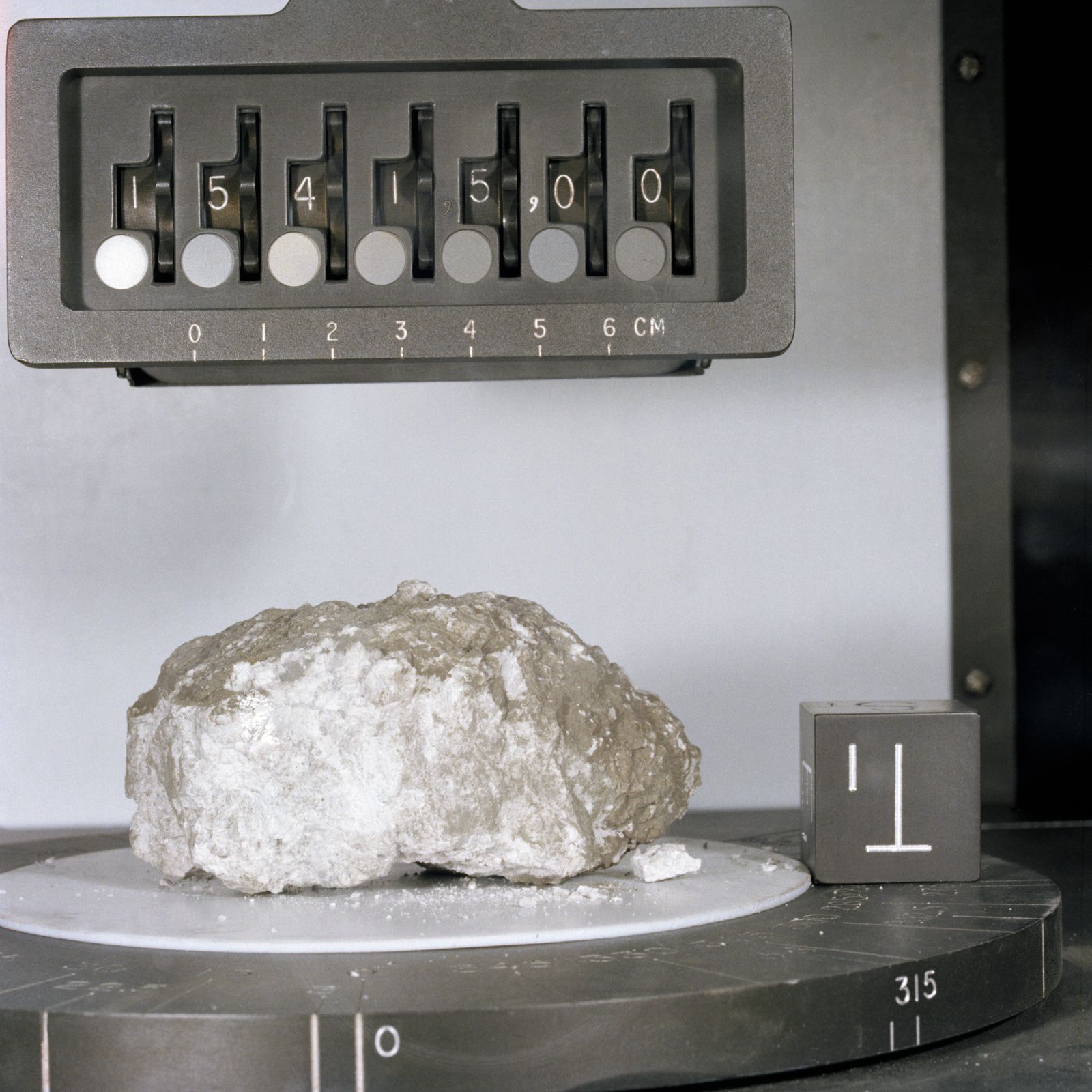
During the second EVA on Apollo 15, Dave Scott and Jim Irwin climbed part of the way up Hadley Delta — the mountain that forms part of the eastern wall of their landing site. They were looking for outcrops, for material that would give them a sample from the original lunar highlands crust. And they found something.
A white rock, clearly different from the gray and brown breccias they’d been collecting. Crystalline, gleaming white, sitting on a small pedestal of finer material as if someone had put it there. Scott said: “There it is. Look at that. Oh, man.” Irwin: “What is it?” Scott: “It’s a plagioclase.”
Plagioclase feldspar. Specifically anorthosite. A rock that forms when magma cools very slowly, when there’s time for the crystals to grow large and the denser material to sink and the lighter material to float to the surface. Anorthosite is a piece of the original lunar crust — the “ferroan anorthosite” that formed when the entire Moon was covered by a magma ocean 4.5 billion years ago. It floated to the surface as the lighter material and hardened as the Moon cooled.
Four billion years old. Give or take. They’ll date it precisely in the laboratory, but the rough age estimate based on the rock type is around 4 billion years. This rock was part of the Moon’s original surface. It was there before any of the mare basalts that fill the great impact basins. It was there before Earth had multi-celled life. It was there, sitting on the side of a mountain, for four billion years, until Dave Scott’s hands reached out and picked it up.
They called it the Genesis Rock.
I read this and I had to set down the newspaper.
I’ve been following this space program for ten years. I’ve watched every launch. I’ve read the mission reports. I’ve developed what I think is a genuine interest in the science of it — I know the difference between mare basalt and highland breccia, I know what a rille is, I know what the ALSEP does. I have learned things from following this program that I didn’t expect to learn.
But the Genesis Rock hit me differently. This is not a rock from the Moon as it currently is. This is a rock from the Moon as it was becoming. Four billion years ago. The solar system was young. Earth was young. The Moon was cooling from a magma ocean. The continents on Earth hadn’t formed yet. There was no life anywhere.
And in that ancient time, this piece of the original crust hardened and sat there and waited. Through every meteor impact, through every lava flow that filled the great basins, through every billion years of slow cooling and cosmic weathering — it waited on the side of a mountain at Hadley Delta. And then, in 1971, a man named David Scott came to collect it.
I find this deeply, almost embarrassingly moving. A piece of the beginning, retrieved for study. A window into the earliest history of the Earth-Moon system. Whatever we find when we analyze it will tell us something we couldn’t have known any other way.
That’s why we’re going to the Moon. Not just for the engineering. Not just to beat the Soviets. For this. For the Genesis Rock, sitting on a mountain at Hadley, waiting four billion years to be found.