Galileo Galilei, around 1590, is supposed to have dropped two balls of different mass from the Leaning Tower of Pisa to demonstrate that objects fall at the same rate regardless of weight. On Earth, this experiment is complicated by air resistance — a feather and a hammer dropped together will not land at the same time because the feather encounters more drag relative to its weight. But in a vacuum, with no air resistance, the theory says they should fall together.
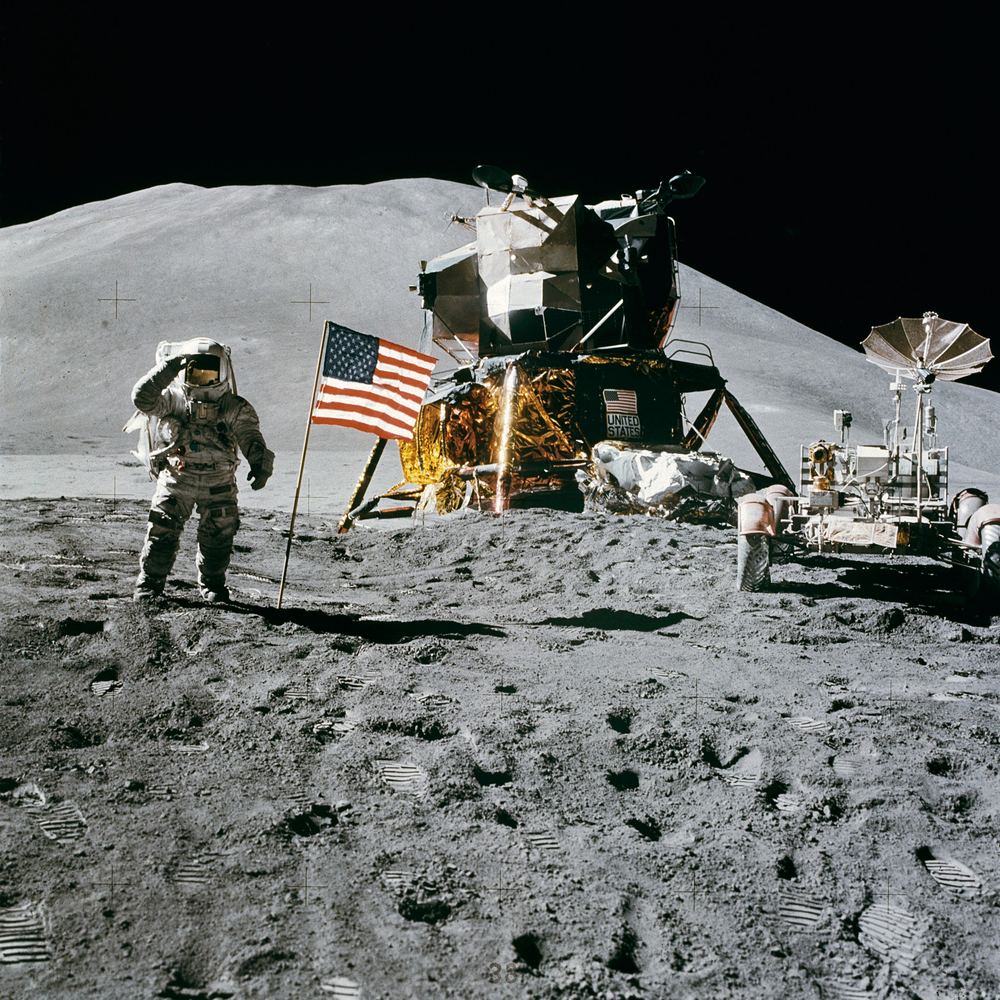
On Earth, achieving a true vacuum large enough to demonstrate this dramatically is difficult. On the Moon, there’s no atmosphere at all. And in August 1971, at the Hadley-Apennine landing site, there was a man named Dave Scott who wanted to prove it.
At the end of the third and final EVA, Scott faced the camera. He said: “In my left hand, I have a feather. In my right hand, a hammer. I’ll drop the two of them here, and hopefully they’ll land at the same time.” He held them up — you could see them on the television, the hammer in one hand, the white feather (from a falcon, the mascot of the Air Force Academy, Scott’s alma mater) in the other. He dropped them simultaneously.
They hit the surface at the same moment. Exactly the same moment. In the low-resolution television footage, you can see the little puff of dust from each impact, both puffs appearing at the same instant. The Moon doesn’t care which one is heavier. Gravity accelerates them identically in the absence of air resistance. Galileo, 380 years ago, was right.
Scott said: “How about that. Mr. Galileo was correct in his findings.” This is technically true and also somewhat understated, but Scott is an astronaut and an engineer, not a poet.
I watched this on television and I laughed, and then I felt something that took me a moment to identify. It was joy. Pure, clean, uncomplicated joy. A man on the Moon proved a 400-year-old theorem with a feather and a hammer, live on television, and it was right. It was just right. Science working. History being honored. The Moon being the best possible laboratory for this particular demonstration.
We live in a world where a man can stand on the Moon and drop a feather and a hammer and prove that Galileo was right. I keep saying this to myself and it keeps being true.
I clipped the newspaper photograph — Scott holding up the feather and hammer before the drop — and added it to my folder. Twelve inches of geological science and four hundred years of physics, on the surface of the Moon, on live television, on a Tuesday morning in 1971.
Some things are just wonderful.