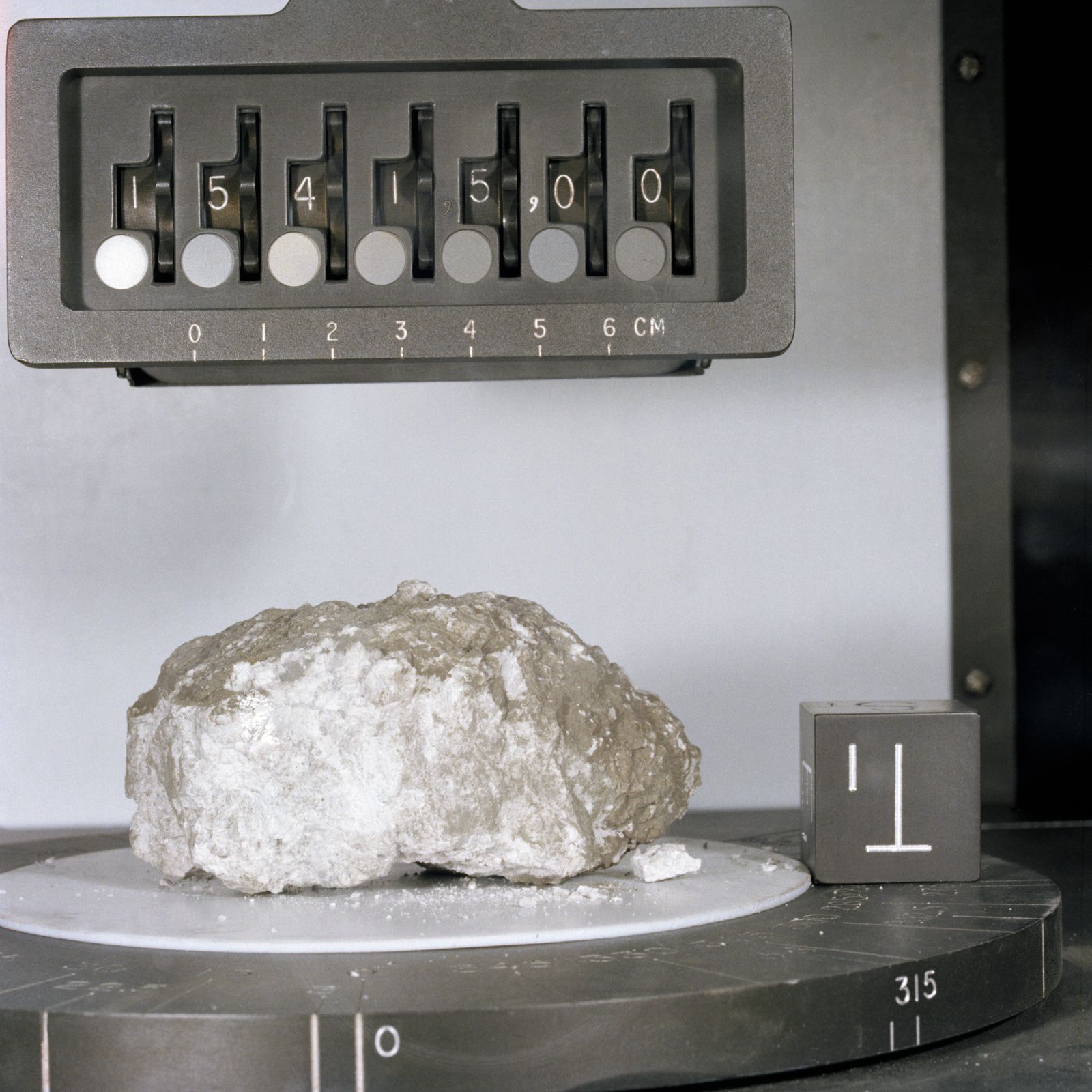
The Genesis Rock from Apollo 15 has been dated: 4.5 billion years old.
Scott and Irwin found the rock at Spur Crater on August 1st — a bright white piece of anorthosite sitting on a boulder, isolated from the surrounding darker basalt. They immediately recognized it as what the geologists had been hoping for. Scott said, “Guess what we just found?” Irwin said he thought it was what he thought it was. Mission Control went quiet for a moment.
4.5 billion years. As old as the solar system itself. As old as the Moon.
This rock formed when the Moon was less than 100 million years old — possibly within tens of millions of years of formation. It’s a piece of the original lunar crust, crystalized from the magma ocean that covered the early Moon. It has been sitting there on that boulder for four and a half billion years, undisturbed except by whatever micrometeorites happened to hit nearby.
For context: the Earth is 4.54 billion years old. The oldest rock found on Earth is 4.28 billion years (the Nuvvuagittuq formation in Quebec, recently revised to possibly 4.28 billion). The Genesis Rock may be older than any natural Earth rock accessible to us.
The oldest rock any human being has ever held.
Scott and Irwin were wearing pressurized gloves, so they didn’t actually touch it in the usual sense — the suit mediates the contact. But they picked it up. They put it in a bag. They brought it home.
I keep writing about the rocks because the rocks are the science. The flag is the symbol. The footsteps are the achievement. But the rocks are what we went for — the hard data, the geological archive, the record of things that happened before there were eyes to see them.
4.5 billion years old. In a laboratory in Houston. Because two men drove a rover to a crater’s edge and looked in the right place at the right time.