Mariner 9 entered Martian orbit in November 1971 and became the first spacecraft to orbit another planet.
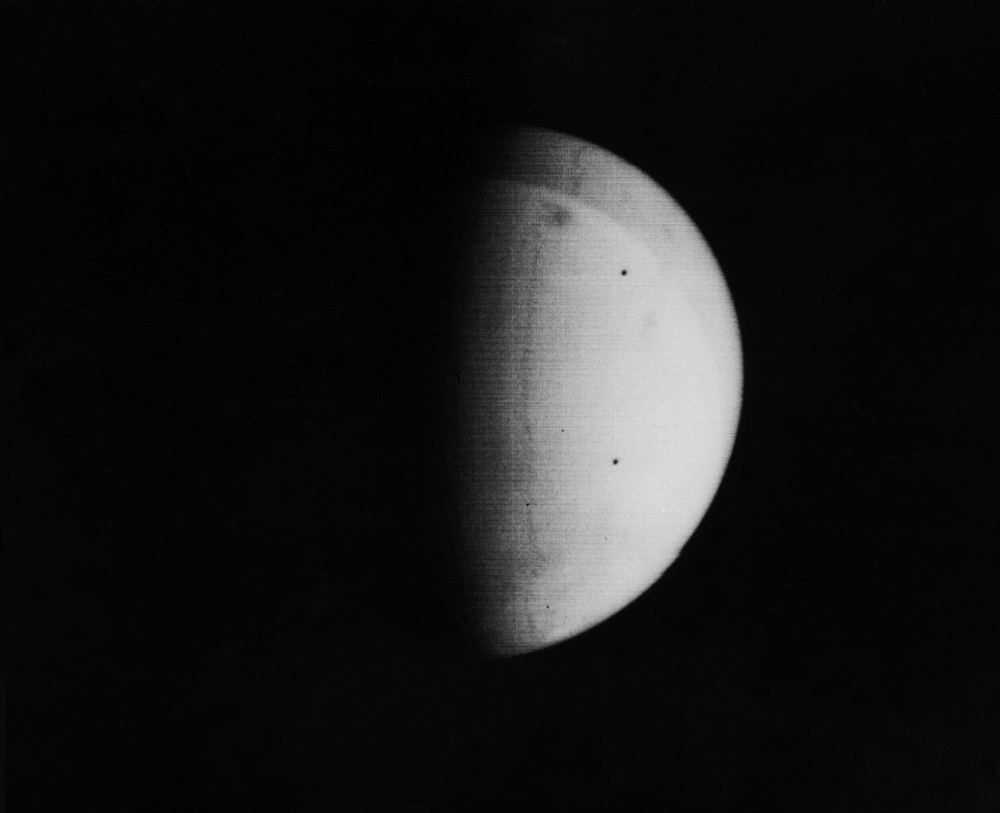
It arrived during a global dust storm — the entire surface of Mars was obscured by suspended particles. For weeks, Mariner 9 waited in orbit while mission controllers delayed activating the camera systems. Eventually the storm cleared, and what was revealed was extraordinary.
Olympus Mons: a shield volcano 16 miles high and 370 miles across. The largest volcano in the solar system. Standing three times taller than Mount Everest. Larger than the state of Arizona. The caldera at the top is 53 miles wide.
Valles Marineris: a canyon system that stretches 2,500 miles across the Martian surface, up to 7 miles deep, up to 60 miles wide. If placed on Earth, it would span the continental United States. The Grand Canyon is a small tributary by comparison.
Ancient river channels: features that look unmistakably like dried riverbeds, winding across the Martian surface. The implication — not confirmed but strongly suggested — is that Mars once had liquid water on its surface. A warmer, wetter Mars in the ancient past. What happened to it, nobody is sure yet.
The polar ice caps: clearly visible, growing and shrinking with the seasons. Made of frozen carbon dioxide (dry ice) primarily, but possibly water ice as well.
Mariner 4 in 1965 showed us a cratered, Moon-like surface. Mariner 9 shows us a geologically complex world with the largest volcano in the solar system, the largest canyon, and evidence of past water.
We had the wrong picture of Mars from Mariner 4. Mariner 9 gave us the right one.
Mars is not the Moon. Mars is a world with a history.