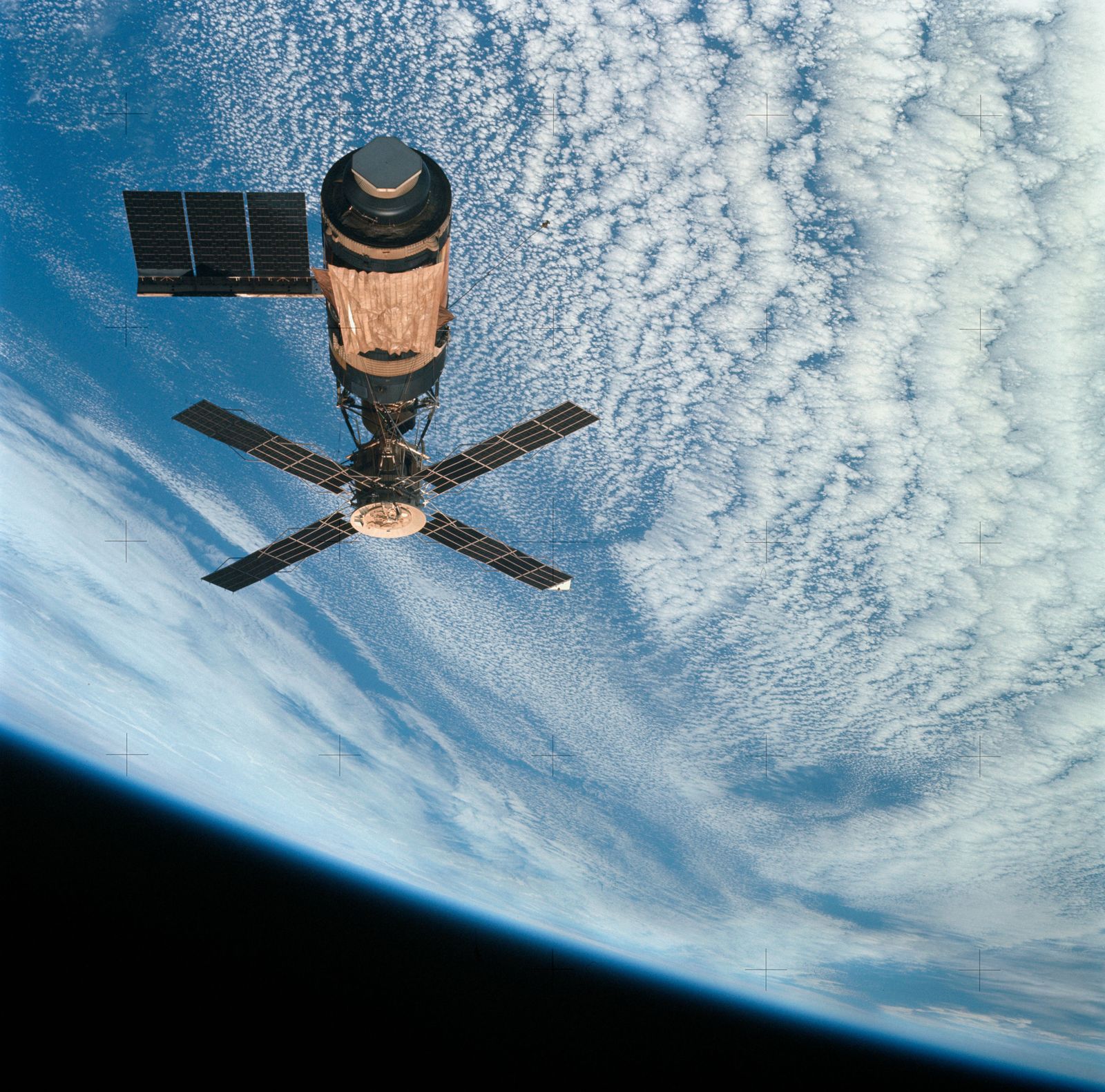
The Skylab space station launches in May and the first crew follows shortly after. After Apollo, this is what comes next for American human spaceflight.
Skylab was built inside the third stage of a Saturn V rocket — the S-IVB stage, which normally would fire to send Apollo toward the Moon. Instead, it’s been converted into a habitat: solar telescopes, living quarters, a workshop, an airlock for spacewalks. It’s the largest American spacecraft by volume ever launched.
The scientific program is extensive. Solar physics is the centerpiece: Skylab carries the Apollo Telescope Mount, a set of eight solar telescopes designed to observe the Sun in ultraviolet and X-ray wavelengths that the Earth’s atmosphere blocks. Ground-based solar astronomy is limited to visible light; Skylab will see the Sun in wavelengths that reveal the corona, solar flares, and the structure of the solar atmosphere in ways never possible before.
Earth resources: cameras and sensors to photograph the Earth’s surface systematically. Geology, agriculture, ocean conditions, atmosphere. The Apollo missions took photographs of the Earth from the Moon and changed how we think about our planet; Skylab will do systematic Earth observation from orbit.
Long-duration human spaceflight: the three Skylab crews will stay 28 days, 59 days, and 84 days respectively (if the mission planning holds). Eighty-four days is more than three times longer than the longest previous American spaceflight. The medical data will be critical for planning any future Mars mission.
The crew is different from the Apollo pilots: Skylab has scientist-astronauts. Geologist Jack Schmitt walked on the Moon on Apollo 17. Astronomer-physician Joe Kerwin flies on Skylab 2. Scientists, not just test pilots. This is the program maturing from demonstration into operation.
I’ve been following this program since Sputnik and I’m going to follow Skylab too. The Moon program is ending. The space station program is beginning. The physics continues.
Forward.