Last weekend I spread my clipping collection across the living room floor.
Seventeen shoeboxes. The first items: April 1961, Gagarin’s flight, the Evening Star and the Washington Post and the New York Times, all reporting the same fact in their different voices. A man named Yuri Gagarin orbited the Earth. One hundred and eight minutes. First human being in space.
Betty stood in the doorway of the living room looking at the sea of newsprint and said: “I told you so.” She meant, of course, that she had always said I had a problem. A filing problem. A collection problem. A space program problem.
She wasn’t wrong.
I sat on the floor in the middle of it all for a while, not reading, just looking. The sheer volume of it. The yellowing paper. The photographs — NASA photographs, mostly, because newspapers in the 1960s used a lot of NASA photographs. The crew portraits. The launch shots. The surface images. The one I come back to most often: the Earthrise photograph from Apollo 8, Bill Anders’s picture of our home planet rising above the lunar horizon. Blue and white and brilliant against the black. It’s in my collection several times — different newspapers, different print qualities, but the same image.
I found the article from May 25th, 1961 — Kennedy’s speech to Congress. “Before this decade is out.” I remember reading it on the bus. I remember going cold with the ambition of it. Eight years seemed like a lot at the time. It was barely enough.
I found the article from January 28th, 1967. The one I cut out the morning after Grissom and White and Chaffee died. The crew photograph is in there too — the one of them in their suits, smiling, in front of the spacecraft. I cut it out when it ran and put it in the file. Looking at it now I remember sitting at my desk in January 1967 and not knowing what to write, and writing anyway because I felt I owed them a record.
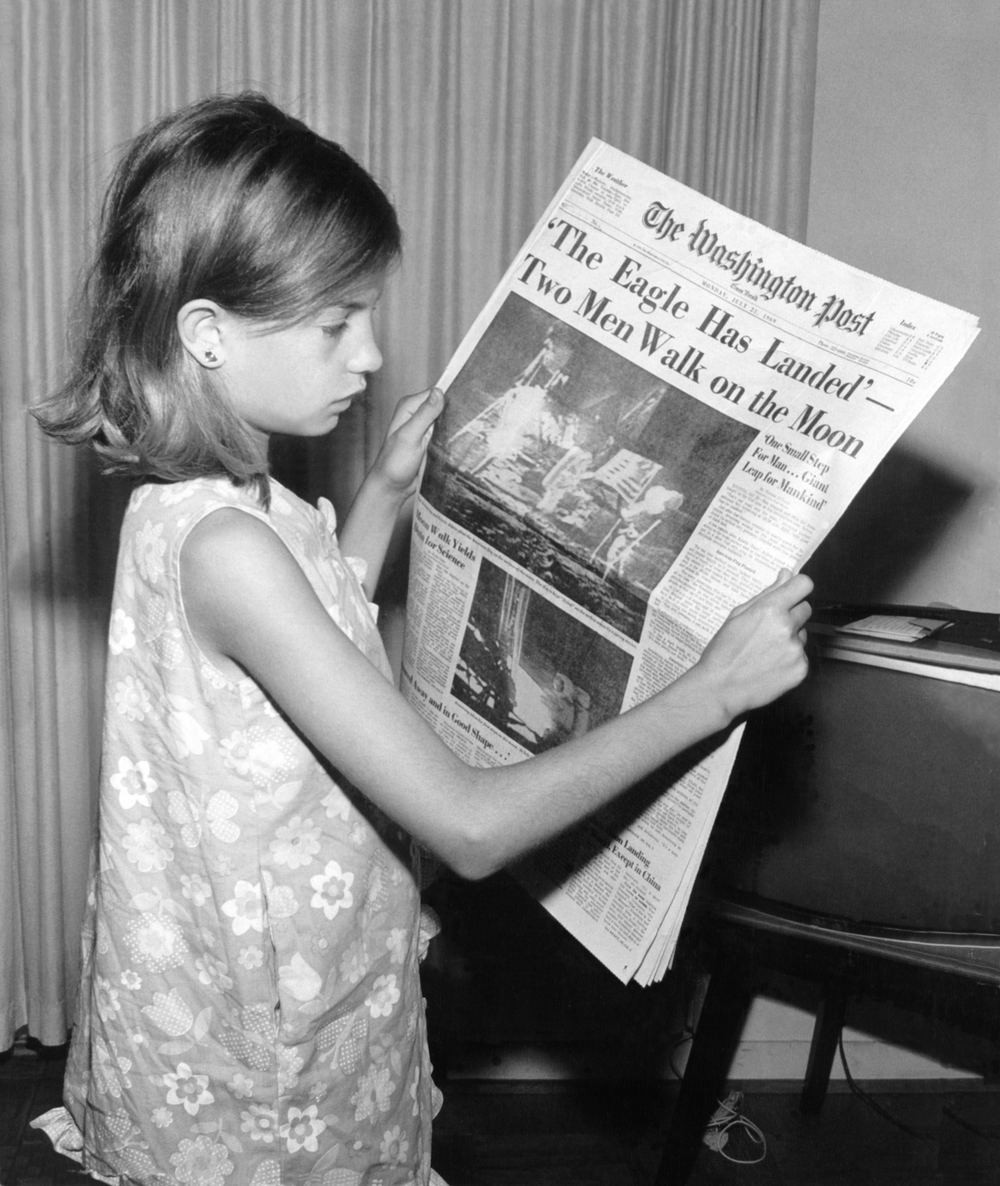
I found the article from July 21st, 1969 — the morning after the landing. Front page, every paper. “MAN WALKS ON MOON.” The simplest headline. The most extraordinary thing ever printed under a headline.
Betty brought me coffee and sat on the arm of the couch and watched me flip through stacks. She didn’t say anything for a while. Then she said: “You should keep all of this.” I said I had been keeping it. She said: “No, I mean organized. Put it together properly. Dates, missions, what happened.” Like a record. Like a book.
I thought about this. Maybe she’s right. Maybe the thing I’ve been doing for twelve years — paying attention, clipping, writing entries, keeping a record — is actually worth more organized than scattered across seventeen shoeboxes.
Eleven years of the space program, from first orbit to last moonwalk. I watched all of it. I’m not sure what to do with that now. But I know I’m not throwing any of it away.
Even Harold can’t argue with me now. Harold, who said it was all a waste of money. Harold, who came out on his porch the day after the Apollo 11 landing and said, “Hard to believe they were up there.” Harold said I was right. He was wrong. He told me so.
I accept his admission. I always knew we’d get there.