The remaining Apollo missions — 15, 16, 17 — are all going to the lunar highlands, and the scientific community is excited about this in a way that I want to explain.
The maria (the smooth dark plains where Apollo 11 and 12 landed, and the Fra Mauro region of Apollo 14) are geologically younger and compositionally different from the highlands. The maria basalts tell us about volcanism on the Moon from 3.5-3.8 billion years ago. That’s important information. But the highlands are older — they’re the original lunar crust, formed about 4.4 billion years ago when the global magma ocean cooled.
The rock type that makes up most of the highlands is anorthosite — a coarse-grained, pale rock rich in a mineral called anorthite (a calcium-aluminum silicate). Anorthosite forms when a magma cools slowly and the lightest minerals float to the top. When the early Moon had a global magma ocean, the anorthosite crystallized and floated to form the crust. This is the “floatation crust” model.
Nobody has yet returned an anorthosite sample. All the Apollo samples so far have been mare basalt or ejecta from basin impacts. Anorthosite from the ancient crust would allow us to date the age of the lunar crust directly — the oldest thing on the Moon, possibly the oldest accessible rock in the solar system.
There’s also the question of what the bombardment history was. The highlands are covered with ancient craters, telling us about the “late heavy bombardment” period 3.9 billion years ago — when the inner solar system was pelted with debris. This same bombardment affected Earth, but Earth has no surviving record. The Moon does.
Apollo 15’s landing site at Hadley-Apennine is at the edge of the Apennine mountain range — mountains that were thrown up by the Imbrium basin impact. The mountains are made of whatever was deep in the crust when the Imbrium event excavated it. This is geological stratigraphy — reading the layers. What’s in those mountains is what was deep in the Moon’s crust four billion years ago.
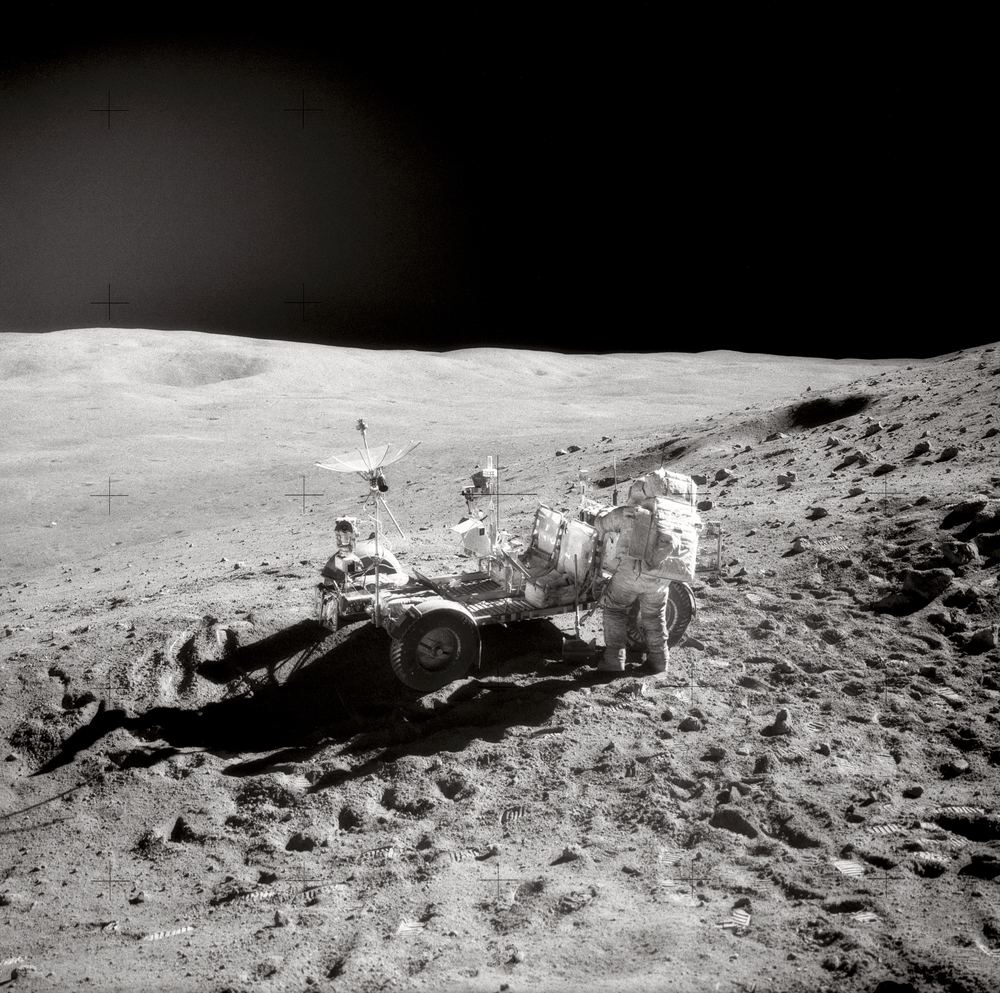
Also: for the first time, Apollo 15 will carry a rover. The Lunar Roving Vehicle. They’re going to drive on the Moon.
I have to say that again: they’re going to drive on the Moon. Not walk, not bounce, not shuffle through regolith. Drive.