Harrison Schmitt, the geologist, earned his place on this mission today.
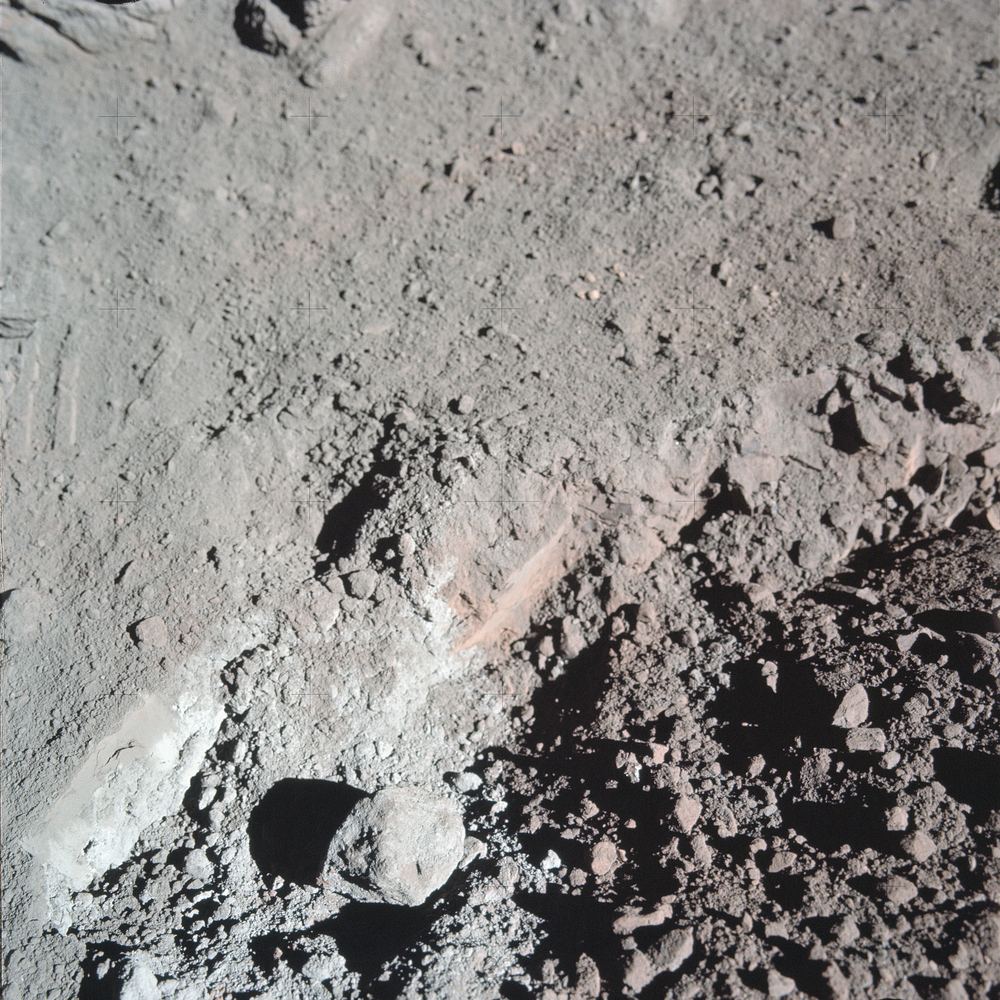
During the second EVA at Taurus-Littrow, Schmitt and Gene Cernan drove the Rover to a crater designated Shorty Crater. It’s about 110 meters across, and the reason they wanted to visit it was that orbital photography suggested the crater might have been formed by a volcanic event rather than an impact. If so, material thrown up from depth — from below the surface — might be exposed in the ejecta. Old material, buried material, might be accessible at the surface around the crater rim.
Schmitt crouched down to examine the surface near the rim. And he said: “There’s orange soil!”
Orange soil. On the Moon. The grays and browns and blacks of everything they’d seen across all twelve missions, and here was a vivid orange patch in the regolith. Cernan came over. “Well, don’t move it till I see it,” Cernan said. Schmitt: “Hey, it’s all over! Orange!”
The excitement in their voices is genuine. You can hear it on the recording. A scientist who has spent months being methodical and precise and trained, suddenly looking at orange dirt on the Moon. He knew what it might mean. He knew it was important. He was not acting calm.
The initial theory — volcanic activity, recent relative to the Moon’s history — was exciting. If the orange soil indicated recent volcanism, that would upend the understanding of the Moon as geologically dead. It would mean the Moon is still active somehow. It would mean the story is longer and more complicated than we thought.
Later analysis — which I’ve been reading about in the preliminary reports — suggests something different and in some ways even more remarkable. The orange soil is glass beads. Ancient volcanic glass beads, formed about 3.5 billion years ago when pyroclastic eruptions threw molten material into the vacuum, and the tiny droplets cooled instantly into glass beads. They’re ancient, not recent. But they’re volcanic. And they were buried under meters of impact regolith until Shorty Crater dug them up and left them on the surface.
Schmitt collected samples. The beads are coming back to Earth. The story of what exactly happened 3.5 billion years ago at Taurus-Littrow is going to be told by whatever the laboratory analysis reveals.
This is what happens when you send a geologist to the Moon. He sees something that a pilot-astronaut might not have recognized immediately for what it was. He knows what orange soil on the Moon could mean. He goes to the crater because the orbital photography hinted at something. And he finds it.
The Moon is still surprising us. After twelve men and seven landings and nearly four years of missions, the Moon is still surprising us. Every time we go, it gives us something we didn’t expect.