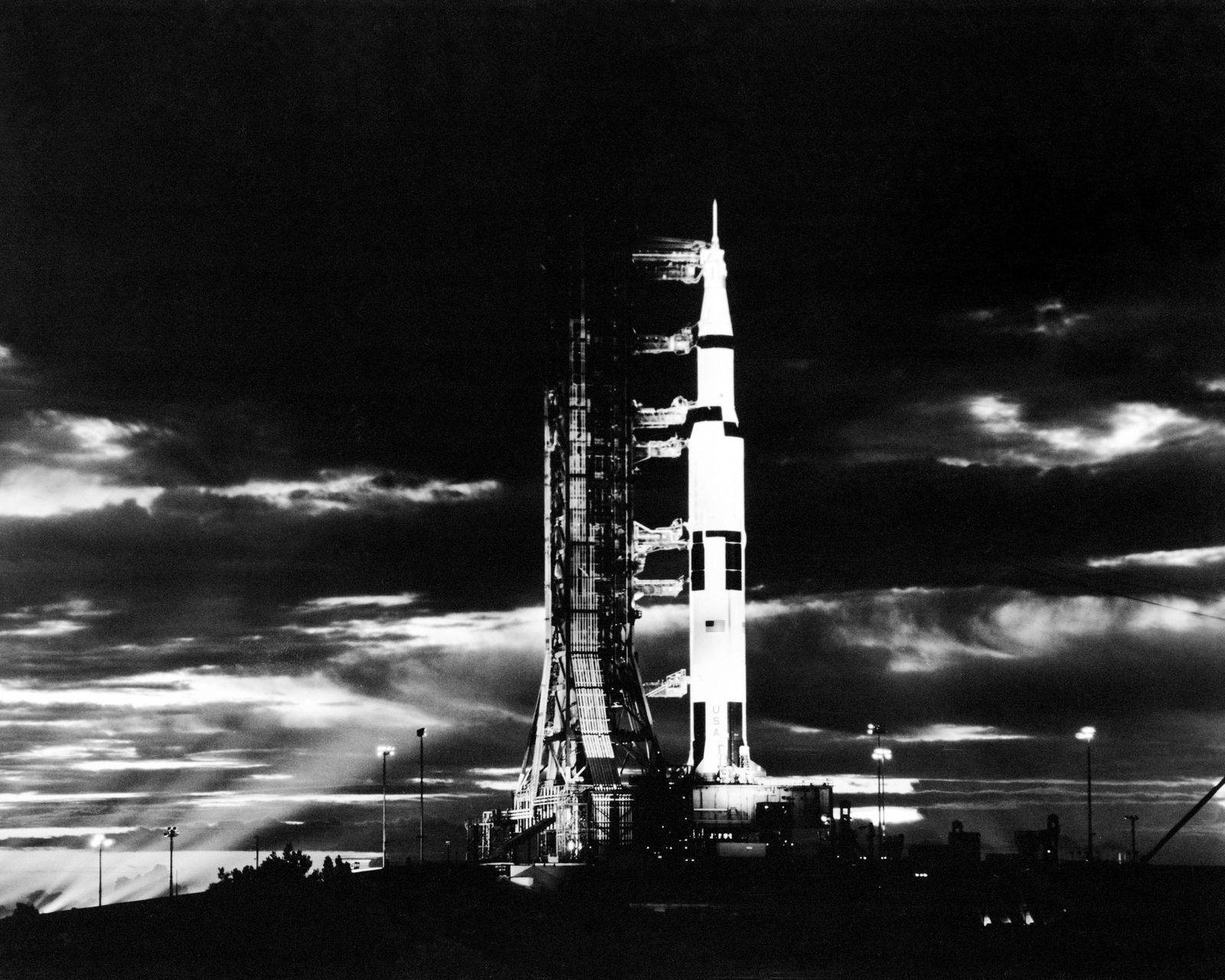
A technical hold pushed the Apollo 17 launch past midnight, which meant the only night launch of the entire Apollo program happened on the morning of December 7th, at 12:33 AM Eastern time.
I sat in front of the television in my dark living room. Betty had gone to bed. The kids are grown now, more or less — they were up for this one, but separately, in their own places. My daughter called before midnight to say she was watching. My son said he’d watch until launch and then sleep, but I doubt he slept.
I watched the darkness at Kennedy Space Center. The floodlights on the Saturn V — all 363 feet of it lit up like a monument against the black sky. The countdown running. The tension of a late-night launch, quieter somehow than a daytime one, more intimate. Just the rocket and the dark.
At 12:33, the engines ignited.
I have watched many Saturn V launches. I have never seen one at night. The television picture showed it all: the fire building beneath the rocket, the incredible brightness expanding outward from the exhaust, the slow rise, and then the thing that no description quite prepares you for — the way the fire lit up the surrounding terrain. The clouds above Kennedy Space Center, the scrubland for miles in every direction, the ocean — all of it illuminated by the rocket’s exhaust as if a second sun had briefly appeared at sea level in Florida.
People 100 miles away reported being able to read newspaper print by the light. Some people 500 miles away in South Carolina and North Carolina reportedly saw a bright light moving north-northeast, uncertain at first what they were seeing. Reports came in from across the southeast: a light in the sky, brighter than anything. The Saturn V rising into the night.
On my television, the launch looked magnificent and terrible and like the end of something.
Gene Cernan, Ron Evans, and Harrison Schmitt are on their way to the Moon. One more time. The last time. Schmitt is the first professional scientist — a PhD geologist — to fly on a lunar mission. He will walk on the Moon. A man who has spent his career studying rocks from the ground will touch the rocks themselves.
Cernan has been here before. He was the last man on the ladder in Apollo 10, eight miles above the surface, having to go back up. He commanded this one. He gets to finish what he started.
I sat in the dark after launch and didn’t turn on the lights for a while. The television was still on, showing the flight path map with the little symbol moving away from Earth. I just sat.
Last time. This is the last time.