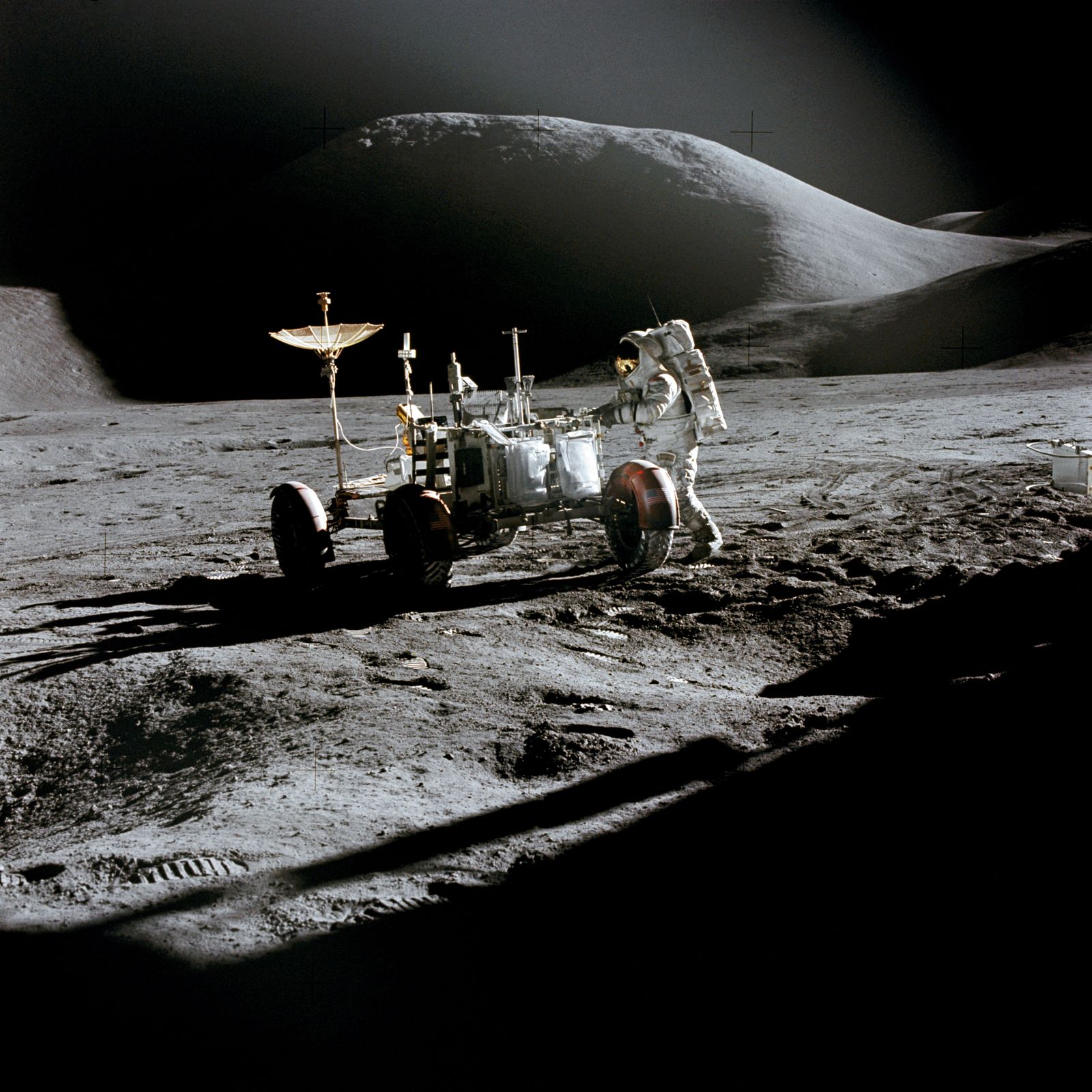
Apollo 15 launched this morning and everything went perfectly, and I am unreasonably excited about an electric car.
Let me explain the Lunar Roving Vehicle. It’s a four-wheeled, electric-powered vehicle that folds up for storage in the descent stage of the Lunar Module. Once on the surface, the crew unfolds and deploys it, charge the batteries using the solar panels and existing power, and drive it across the lunar surface. Maximum speed: about 11 mph. Weight: 460 pounds on Earth (much less on the Moon). Range: about 35 miles before the battery runs out, though mission rules limit the crew to never going farther from the LM than they could walk back if the Rover broke down.
That last rule is important. They’re not taking the Rover as a joyride — they’re using it to extend the range of human exploration on the lunar surface, with the understanding that if it breaks, they have to be able to walk home. The Rover’s battery is precious. Every mile they go out is a mile they might have to walk back.
Dave Scott is the commander. Jim Irwin is the Lunar Module pilot. Alfred Worden will orbit alone in Endeavour, the Command Module. Worden will have the most time alone in space of anyone yet — he orbits for three days while Scott and Irwin are on the surface.
Their destination is Hadley-Apennine: the base of the Apennine mountain range, near a feature called Hadley Rille. The Rille is a sinuous channel — likely a collapsed ancient lava tube — that runs for about 130 kilometers. It’s 1.2 kilometers wide and 300 meters deep in places. They plan to drive to the edge and look down into it. Ancient lunar geology, exposed like a cross-section in a textbook.
I’ve been looking forward to this mission for months, more than any Apollo mission since the first landing. Because Apollo 15 isn’t just going to the Moon and back anymore — it’s going to drive around. It’s going to explore. It’s going to geology the Moon the way geologists geology Earth: moving through a landscape, reading the rocks, understanding the story they’re telling. The science is finally the point, not just the side benefit.
Scott and Irwin trained with geologists for months. They can identify rock types. They know what they’re looking for. They know what would be significant to find and where they might find it.
In four days they’ll land. And then we’ll see the Moon from a moving vehicle for the first time in history.