The United States landed a spacecraft on the Moon today.
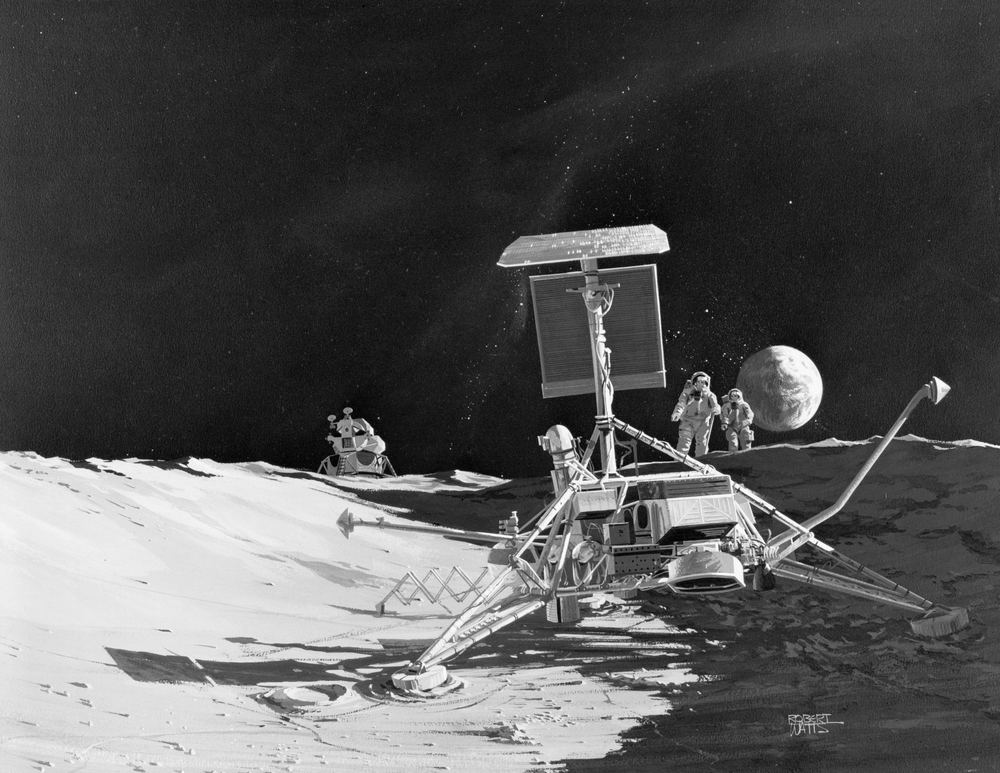
Unmanned, but on the Moon. Softly, without crashing. Surveyor 1.
I realize that sounds anticlimactic compared to putting men up there. But it shouldn’t. This is technically very difficult — you’re flying a spacecraft 240,000 miles, hitting the Moon with precision, decelerating from 6,000 miles per hour to zero at the exact right moment, and landing upright on a surface you’ve never physically examined.
Why does this matter for Apollo? Because nobody actually knew for certain what the lunar surface was like. Some scientists — a minority, but vocal — argued that the surface was covered in a deep layer of loose dust, accumulated over billions of years of meteorite impacts. If the dust was deep enough, a spacecraft would simply sink in. The first image from Surveyor 1 — showing the footpad resting on firm soil — was partly a scientific result and partly an engineering clearance.
The surface is firm enough to support a spacecraft. The dust layer, where there is one, is shallow. A person in a suit, or an Apollo landing leg, would not disappear into a bottomless powder.
This seems obvious in retrospect. Of course the Moon has a solid surface — you can see it through a telescope, you can see the mountains and craters, something solid made all those craters. But “obvious in retrospect” is different from “proven in advance,” and the Apollo planners needed proof.
Surveyor 1 has now taken over 10,000 photographs of the surface around its landing site, showing rocks, dust, craters, textures. Scientists are poring over these images. What they’re learning will influence the site selection for Apollo landings and the EVA planning for the surface.
The Soviets have been trying to land on the Moon since 1963 and have not managed a soft landing until just a few months ago (Luna 9, in February). We just did it on our first attempt. That’s not nothing.
The race has multiple categories. Manned orbit: Soviets. Manned spaceflight first: Soviets. Spacewalk: Soviets, barely. Soft unmanned lunar landing: essentially tie. The overall score is still in Soviet favor, but the American program is technically more sophisticated now, and the endgame — landing people on the Moon — is specifically an American commitment.
The footpad sits in lunar dust, solid, undisturbed. The surface will hold us.
Good news for when the real thing comes.