Gene Cernan tried to do a two-hour spacewalk on Gemini 9 today and had to cut it short after two hours and nine minutes. He was in serious trouble.
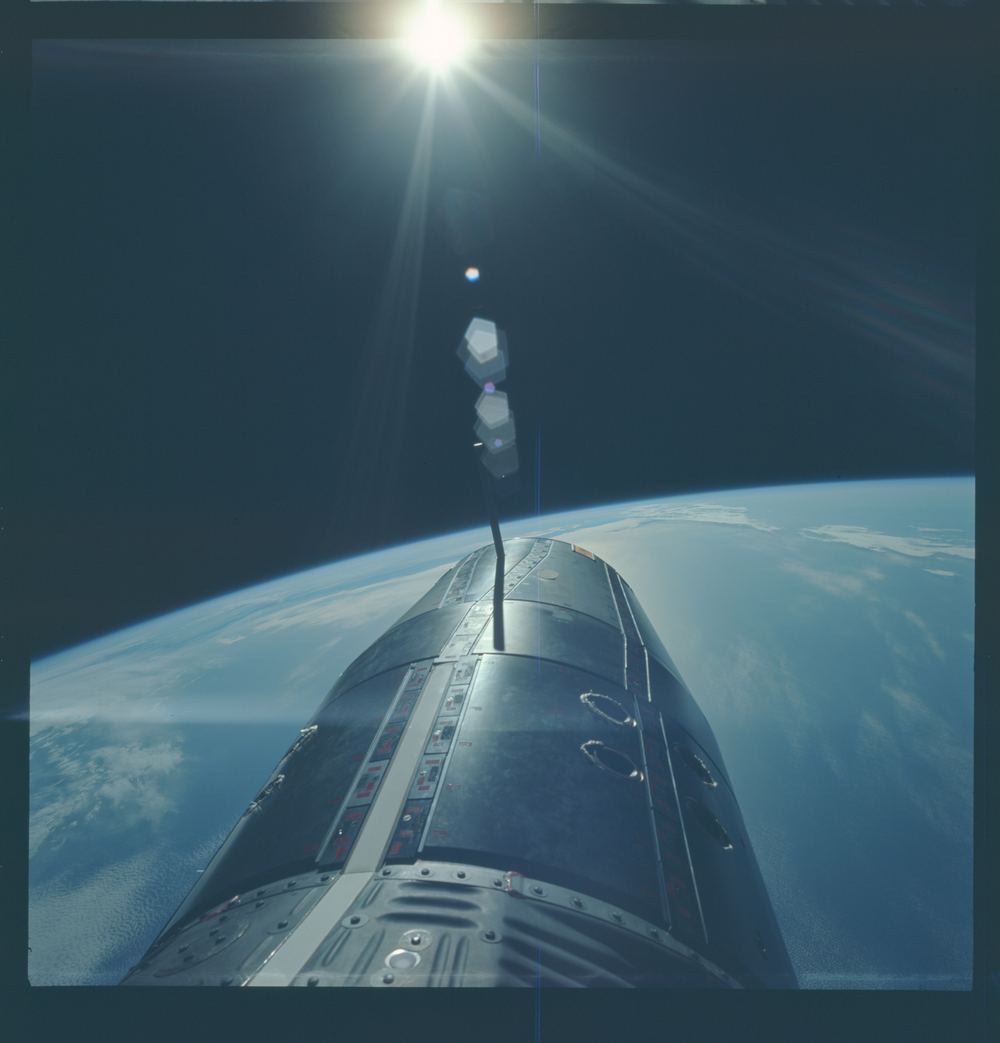
The mission had already been strange before the EVA. Gemini 9 was supposed to dock with an Agena target vehicle, but the Agena malfunctioned and didn’t reach orbit. They launched a replacement target (the Augmented Target Docking Adapter), but when they got to it, the shroud that was supposed to have been jettisoned was still partially attached — open, like a crocodile mouth, as Stafford described it. Docking would have been like “docking with an angry alligator.” They couldn’t do it.
So they moved to the EVA objective. Cernan was supposed to work his way to the back of the Gemini capsule, strap on a jet-propelled backpack called the AMU (Astronaut Maneuvering Unit), and demonstrate independent maneuvering in space. This was a critical test for future spacewalks.
The problem: the work of just moving along the outside of the spacecraft caused Cernan’s metabolic rate to skyrocket, which fogged his visor. The spacesuit’s cooling couldn’t keep up. He couldn’t see. His heart rate was over 180 beats per minute. He never reached the AMU. He had to come back in.
This mission, and Gemini 9 specifically, is why NASA brought in Buzz Aldrin to study underwater EVA training. Aldrin had been doing research on rendezvous and orbital mechanics; he also started designing the neutral-buoyancy training approach that proved critical. His Gemini 12 EVA success didn’t happen in a vacuum — it happened because Gemini 9 showed what wasn’t working.
Cernan was a strong, capable man who nearly overheated on a spacewalk because nobody understood yet how much muscular exertion in a pressurized suit cost in metabolic terms. The suit’s environmental system was overwhelmed.
These problems are why you test. You find out what doesn’t work. You fix it. Cernan went on to command Apollo 17, the last lunar landing. He walked on the Moon for three days and came back fine.
But in June 1966, he was fighting fog on his visor and trying to breathe.