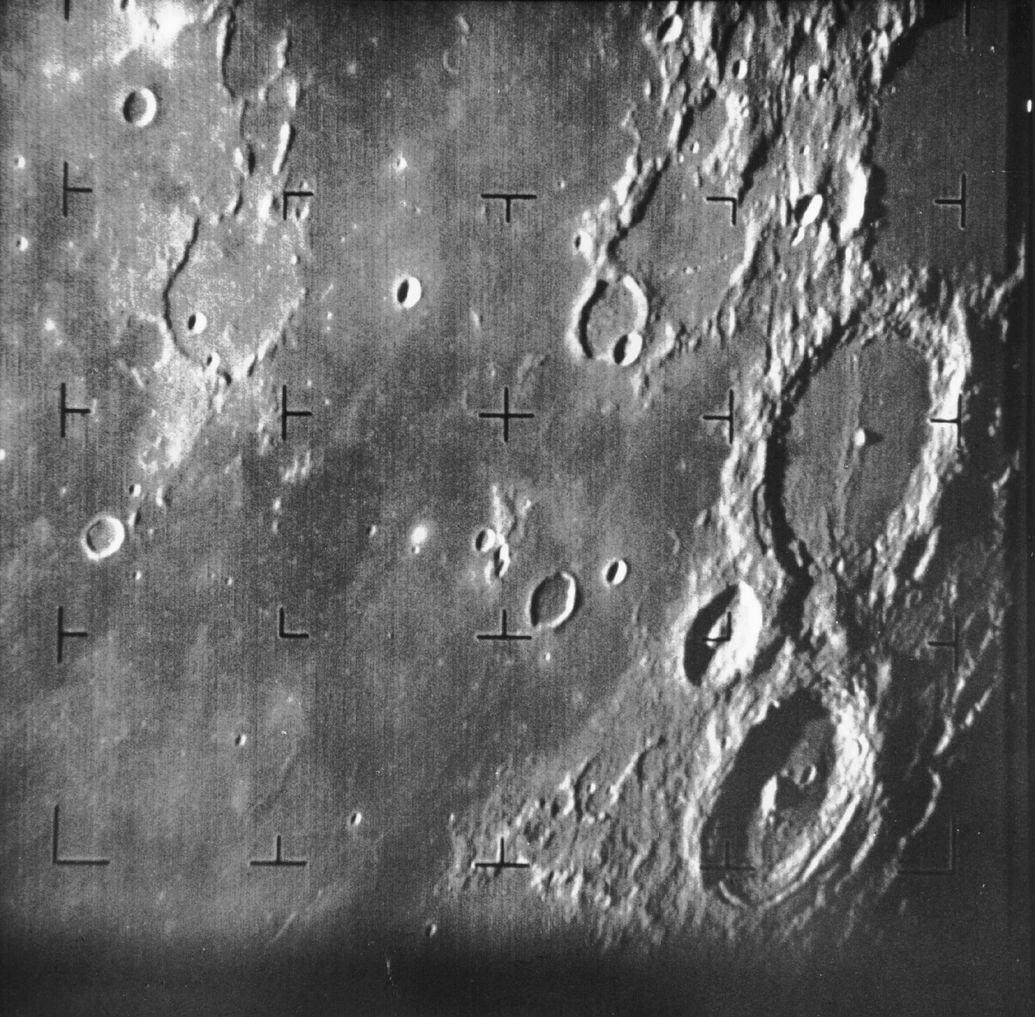
Ranger 7 hit the Moon yesterday after transmitting 4,308 photographs in the last seventeen minutes before impact.
The closest images, taken in the final seconds before the spacecraft hit, show features only a few feet across — detail that no telescope on Earth can approach. The Mare Cognitum landing site is visible in extraordinary clarity. Individual rocks, small craters, surface texture that had been invisible from Earth.
Ranger is a simple mission concept: aim a spacecraft at the Moon, photograph continuously as it approaches, transmit everything back until it hits. No soft landing, no orbit, no return — just a camera on a suicide trajectory, sending pictures all the way down.
The first six Rangers failed in various ways. Rangers 1 and 2 had rocket failures. Rangers 3, 4, and 5 missed the Moon or had equipment failures. Ranger 6 made it to the Moon but the cameras failed before activation. After Ranger 6’s camera failure, there were congressional hearings about JPL management and the reliability of unmanned spacecraft.
Ranger 7 worked. All the way to the end.
What the images show: the Mare Cognitum surface is more complex at close range than it looks from Earth. There are small secondary craters everywhere, rock fragments, subtle differences in surface texture between areas. The Surveyor program will study specific landing sites in detail, but Ranger 7’s images are the first dataset showing what the surface actually looks like from close range.
The smallest craters visible in Ranger 7’s last images are about a foot across. Surface features that would be completely invisible to Earth-based observation. We are learning the texture of another world, photograph by photograph.
Ranger is a crash program — both in the sense of being intensive and in the literal sense of spacecraft hitting the Moon. But it works. 4,308 photographs. Everything it knew about the Moon, it told us.