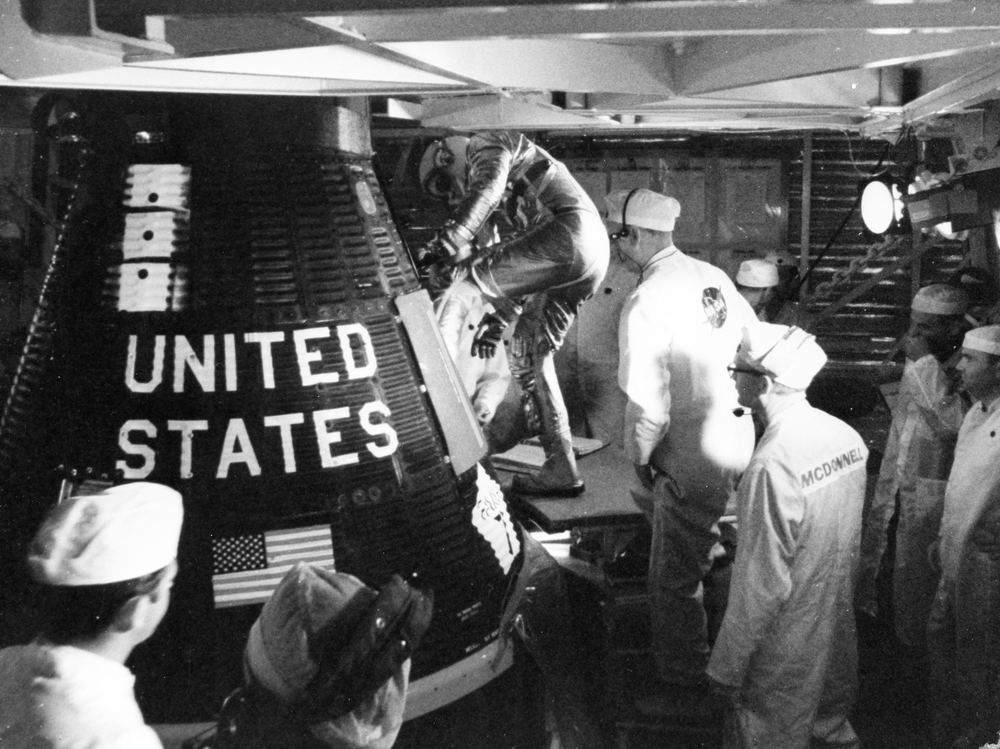
Gordon Cooper became the last American to fly in Mercury today, spending more than 34 hours in space on 22 orbits — longer than all previous American missions combined.
Faith 7. The mission almost didn’t end well. On the final orbit, Cooper’s automatic control system failed completely — a short circuit in the Carbon Dioxide system caused a cascading series of failures that took out the autopilot, the attitude control, and several other systems. Cooper had to fly the entire re-entry sequence manually, calculating the retrorocket firing time himself with a stopwatch and using the stars as his orientation reference.
He landed within four miles of the recovery ship. Manually. With a dead autopilot. Using a stopwatch and star navigation.
The news reports are effusive, and for once, I think they’re entitled to be. What Cooper demonstrated is exactly what the program’s argument for human pilots has always been: a machine cannot improvise. When the automatic systems fail, a human pilot can still get himself home. The question people raised — do you even need a pilot, or is the spacecraft just a fancy can that computers steer? — Cooper answered definitively. You need the pilot.
He also became the first American to sleep in space — he napped twice during the mission. This apparently concerned some people on the ground, but his vital signs were fine and he was rested and alert for re-entry. Good instincts.
Mercury is done. Six manned flights over two years. One capsule sank. One missed its landing zone by 250 miles. One demonstrated that automated systems can fail at the worst moment and a pilot can still bring the ship home. All six men came back alive.
Whatever comes next has to be built on this foundation. The Moon mission requires staying in space much longer than 34 hours. It requires two capsules operating together, docking, transferring crew. It requires leaving the capsule entirely — spacewalking — and working outside the vehicle. It requires navigating not just to Earth orbit but to lunar orbit and back.
Mercury asked: can a human being survive in space? The answer is yes.
Gemini will ask: can a human being work in space? That’s the next question.
I’m going to miss Mercury. This is the beginning, and beginnings have a particular feeling to them — tentative, brave, fragile. The men who flew Mercury did something nobody had done before, with tools nobody was sure would work, in an environment nobody had firsthand experience in. They made it look like something a person could do.
That matters. That will always matter.
Godspeed, Faith 7. Goodnight, Mercury.