Scott Carpenter orbited three times today and then overshot his landing zone by 250 miles. For forty minutes the news reported him missing.
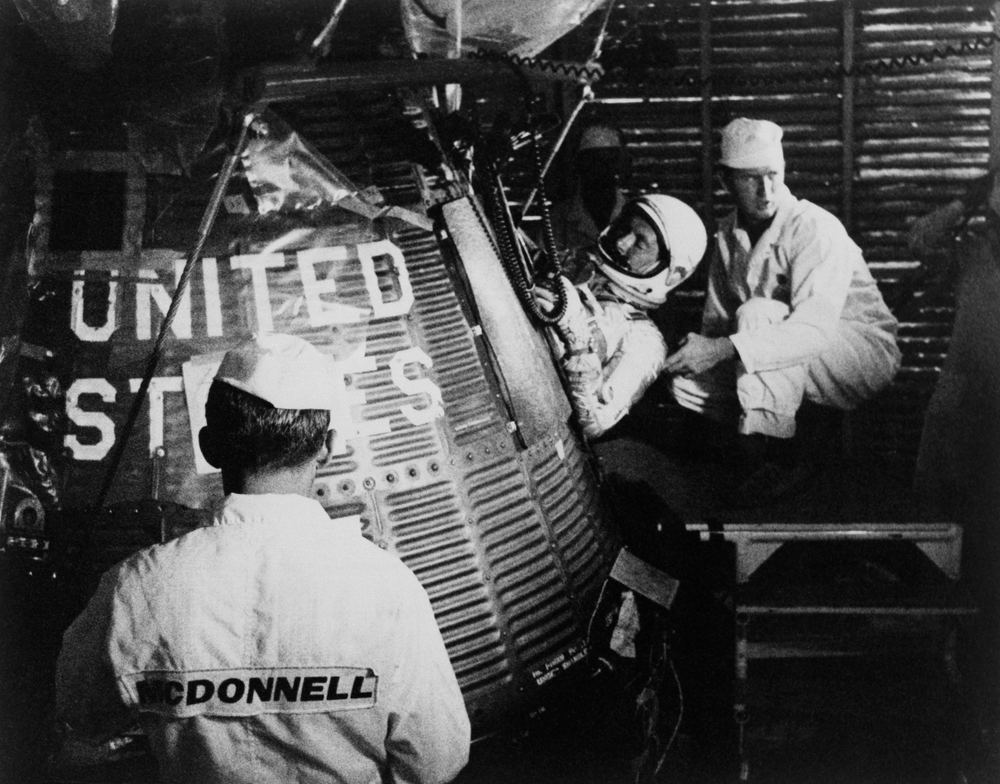
Forty minutes. Betty and I sat in front of the television and watched the commentator explain, carefully, that Aurora 7 had come down somewhere in the Atlantic but they didn’t know exactly where, and the recovery ships were searching.
He was fine. He was found forty minutes later, sitting in a life raft next to his capsule, apparently eating a tube of food and watching the tropical sky. But those forty minutes were awful, and I suspect NASA thought they were awful too, because the post-flight reports are not particularly complimentary.
Here’s what happened, as best I understand it: Carpenter was supposed to be focused on re-entry procedures but got engrossed in observing something outside his window — he described strange luminescent particles that he couldn’t explain (John Glenn had mentioned them too). He was late executing his retrorocket burn, and he also had a hand-controller attitude control problem that caused him to waste fuel. When he did fire the retrorocets, they were slightly misaligned. The combination of the late burn and the misalignment meant he came down much farther from the target zone than planned.
NASA is not publicly criticizing Carpenter. But from what I can read between the lines of the official statements, there are people who are unhappy with his situational awareness during re-entry. A pilot who is distracted by interesting things outside the window while the clock is ticking on a critical procedure sequence has prioritized the wrong thing.
I feel conflicted. On one hand: he’s an astronaut, he was trained, he had a job to do and the re-entry procedure is not the time for sightseeing. On the other hand: he was in space. He could see things no human being had ever been able to see before. The particles he was watching turned out to be frozen condensation from the spacecraft systems — not aliens, not a mystery — but he didn’t know that at the time. Can we really blame a man for being curious up there?
The answer the program will give, I’m sure, is: yes, we can. The spacecraft is a machine that requires correct operation to deliver a man safely home, and curiosity is not a substitute for procedure.
Carpenter won’t fly again in Mercury. I have a feeling about this. He’s safe, the mission accomplished its objectives, but the margin of error in that re-entry was too thin.
The remaining Mercury missions are Schirra and Cooper. After that, Gemini. After that, Apollo.
After that, the Moon.
We’re moving forward, even when individual flights have problems. I think that’s how this works. One step at a time, even when the steps are imperfect.