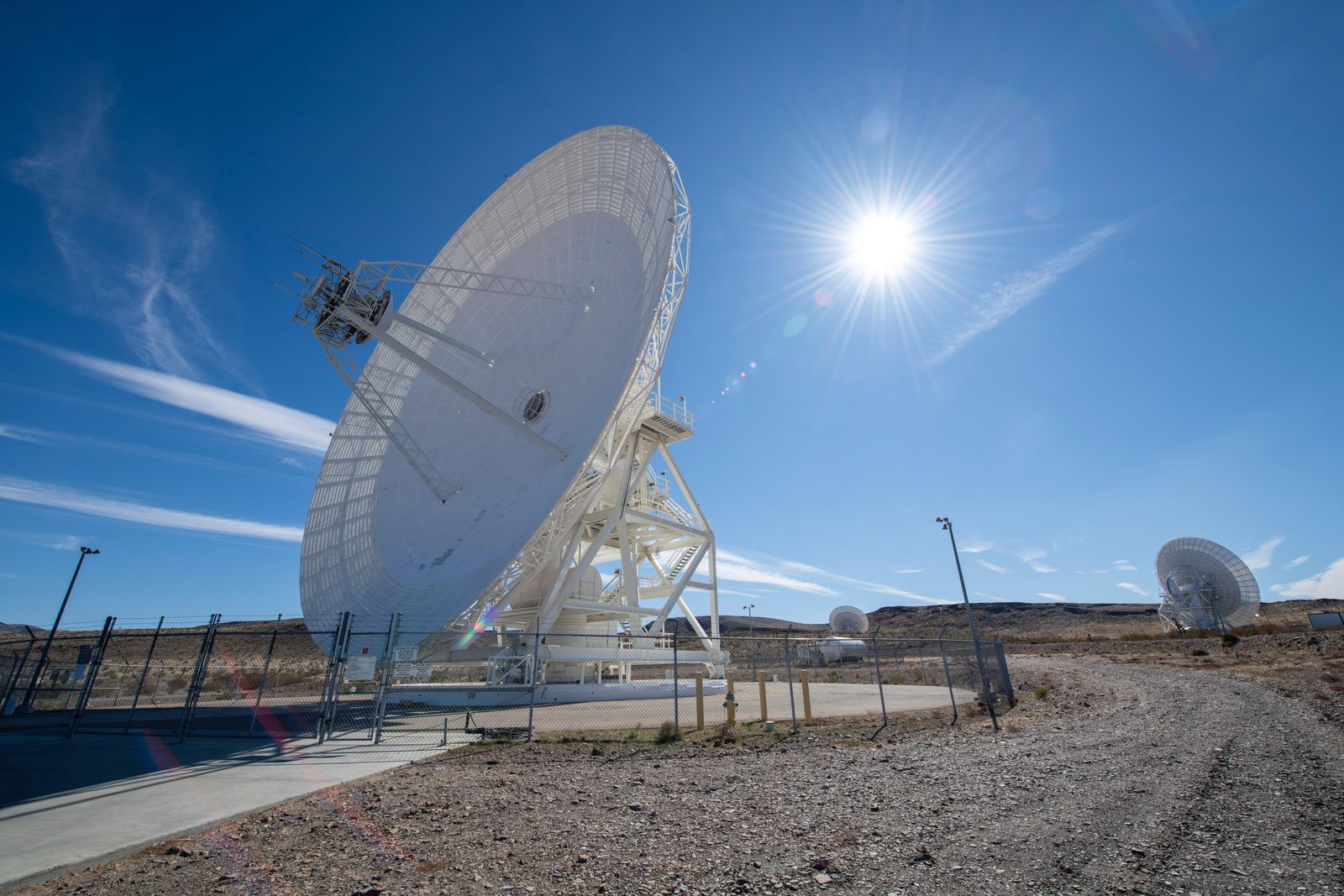
I’ve been reading about the Deep Space Network — the antennas NASA uses to communicate with spacecraft at the Moon and beyond. It’s a global system that had to be built from scratch over the past decade, and it works in ways I’ve found fascinating.
The challenge: you’re trying to have a two-way conversation with a spacecraft 240,000 miles away (Moon), or potentially millions of miles away (Mars, or deep space probes). The signal power at the spacecraft end is limited by how much electrical power the spacecraft can generate, which is limited by weight. The Apollo spacecraft transmitted at about 20 watts from the Moon — about the power of a bright light bulb.
That 20-watt signal, traveling 240,000 miles and spreading out in a sphere, arrives at Earth with almost no power at all — a fraction of a fraction of a watt, spread across a hemisphere. To receive it, you need very large antennas (to collect as much of that diffuse signal as possible) and very sensitive electronics.
The Deep Space Network has three primary complexes positioned around the world at roughly 120-degree intervals: Goldstone in the Mojave Desert in California, the Canberra complex in Australia, and the Madrid complex in Spain. This spacing ensures that as the Earth rotates, at least one complex always has line of sight to the Moon or to deep space probes.
The primary antennas are 85 feet (26 meters) in diameter — huge parabolic dishes that track the spacecraft as the Earth turns. For Apollo communications, these were supplemented by additional stations (Honeysuckle Creek, Parkes) to improve coverage.
The transmitters at these stations are also very powerful when sending to spacecraft — up to 400,000 watts at some sites, to push sufficient signal out to reach Mars or beyond. For the Moon, less power is needed; for deep space probes like the Pioneer spacecraft that are heading toward the outer solar system, the full power is required.
The antennas have to track the Moon (or spacecraft) in real time, continuously adjusting as the Earth rotates. The pointing accuracy required is very high — a mispointed antenna loses signal rapidly. The mechanical engineering of these large dish antennas is impressive in itself: precise azimuth and elevation drives, enough structural stiffness to hold pointing accuracy in wind, and reliable enough to operate continuously.
All of this is invisible to people watching the mission on television. You see the launch and the lunar module and the footprints. You don’t see the antenna in the Australian desert rotating to track a spacecraft, receiving a 20-watt signal from 240,000 miles away, turning it into the voice of an astronaut.
But without it, we can’t hear them. Without it, they can’t hear us. Without it, Mission Control can’t give the crew the procedures that save their lives.
The Deep Space Network kept them all alive. Nobody made a television special about it.