The preliminary examination of the Apollo 11 and 12 samples is complete and the initial scientific papers are out. I’ve been reading them — or reading the summaries, since the papers themselves require a geology background I don’t have.
Here’s what we know from the first two landings.
Age: The Apollo 11 basalts from the Sea of Tranquility are 3.7 billion years old — confirmed by argon-argon dating. The basalts crystallized from lava that flowed 3.7 billion years ago, before complex life existed on Earth (Earth’s oldest confirmed life is about 3.5 billion years old). The Apollo 12 samples from the Ocean of Storms are 3.2 billion years old — younger, suggesting different lava flow events at different times.
Composition: The Apollo 11 basalts are high in titanium — much more than typical Earth basalts. The Apollo 12 basalts are lower in titanium. This variation tells us the lunar mantle has compositional differences from region to region, which is useful for understanding how the Moon formed and differentiated.
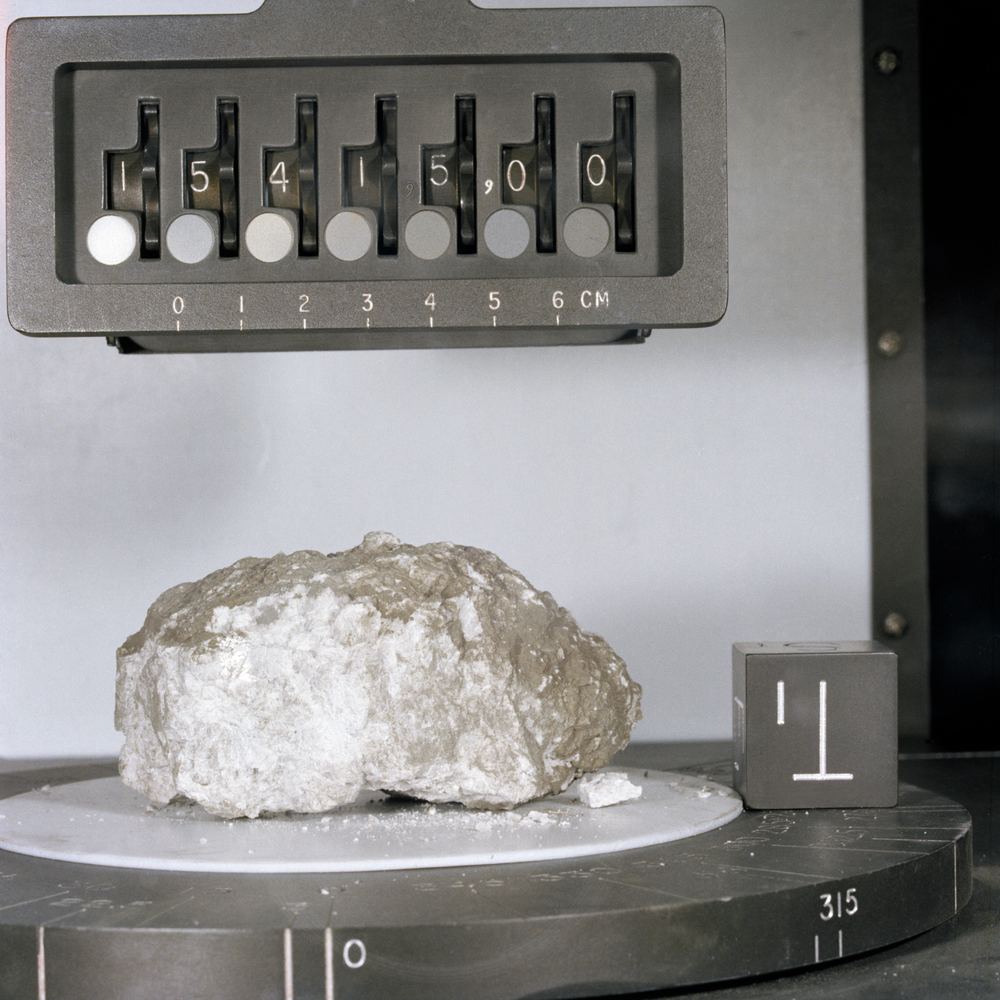
Regolith: The surface soil is a complex mixture of crystalline rock fragments, glass (from meteorite impact melting), and agglutinates — small particles bonded together by glass. The glass spherules are omnipresent, forming from the spray of melt created by micrometeorite impacts.
Water: None detected in any sample. The Moon is drier than the driest place on Earth by many orders of magnitude. This is consistent with the giant impact formation hypothesis — if the Moon formed from high-temperature debris thrown off by a collision, any water would have boiled away.
Shock metamorphism: The samples show extensive evidence of shock from meteorite impacts — mineral grains with planar deformation features, glass veins from shock melting, fractured crystals. The bombardment record is written in the structure of every grain.
Forty-seven pounds from Apollo 11. Seventy-five from Apollo 12. This is a tiny fraction of what we eventually need, but it’s changed the geological picture of the inner solar system in fundamental ways.
We’ve been to the Moon twice and we know more about how it formed than we knew before either visit. That seems like the right exchange.