Apollo 12 launches today with Pete Conrad, Al Bean, and Dick Gordon. We’re going back to the Moon. That still sounds unbelievable.
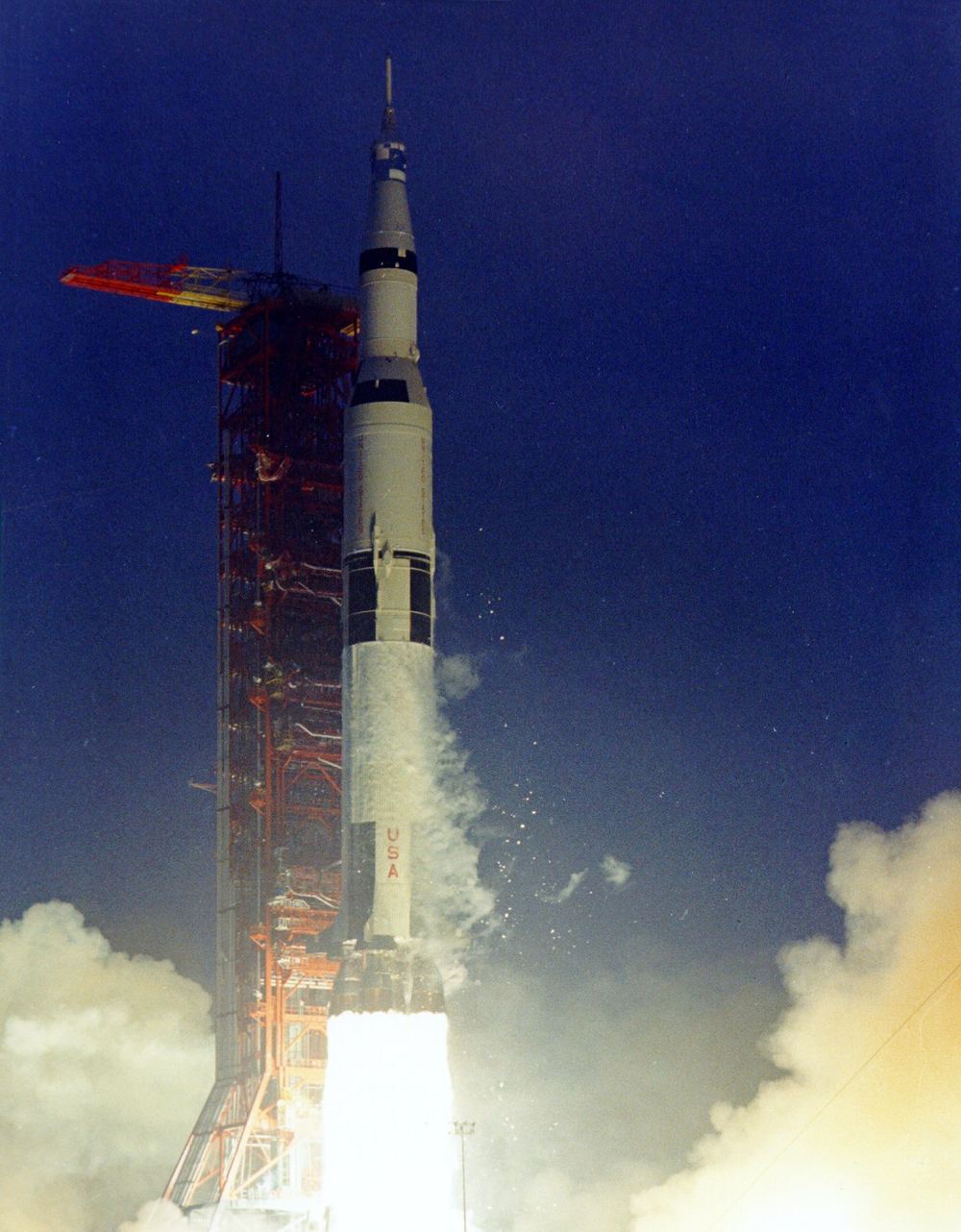
We’re going back. A second time. As if this is something we do now, as a civilization — go to the Moon, come back, go again.
It’s not routine. I want to be clear about that. Nothing about Apollo 12 is routine. The Saturn V, which I wrote about in terms that make it sound formidable (because it is), struck by lightning twice just after launch today. Twice. The electrical system went haywire, circuit breakers tripped, mission controllers and astronauts scrambled to understand what had happened.
A controller named John Aaron recognized the problem from a training exercise — the power situation looked identical to something he’d seen before on a test — and told the crew to throw an obscure switch called “SCE to AUX.” Conrad, who didn’t know that switch, asked the crew. Alan Bean remembered it and threw it. The systems recovered.
They continued to orbit and to the Moon. The lightning strike doesn’t appear to have damaged anything critical.
I’ve been following Pete Conrad since Gemini 5. He’s shorter than most of the astronauts, louder, funnier — where Armstrong is careful and precise and economical, Conrad is expansive and enthusiastic. He reportedly made a bet with a journalist that he could say anything on the Moon and it would be reported reverentially. His plan was to say something irreverent on the first step. I’ve been told he’s prepared for it.
Al Bean is on his first spaceflight. He’s been training for years and is reportedly one of the most technically skilled people in the program, but this is his first time in space.
They’re heading for the Ocean of Storms — farther from the equator than Tranquility, more technically challenging landing site. And they’re aiming to land precisely enough to visit Surveyor 3, the unmanned spacecraft that landed there in 1967. If they can do that — land within walking distance of a spacecraft they targeted from the ground — it proves the precision landing capability that future missions will need.
Go, Pete. Say whatever you have planned. Bring the country along with you.