Apollo 12 launched today and I am still a little shaky from watching it.
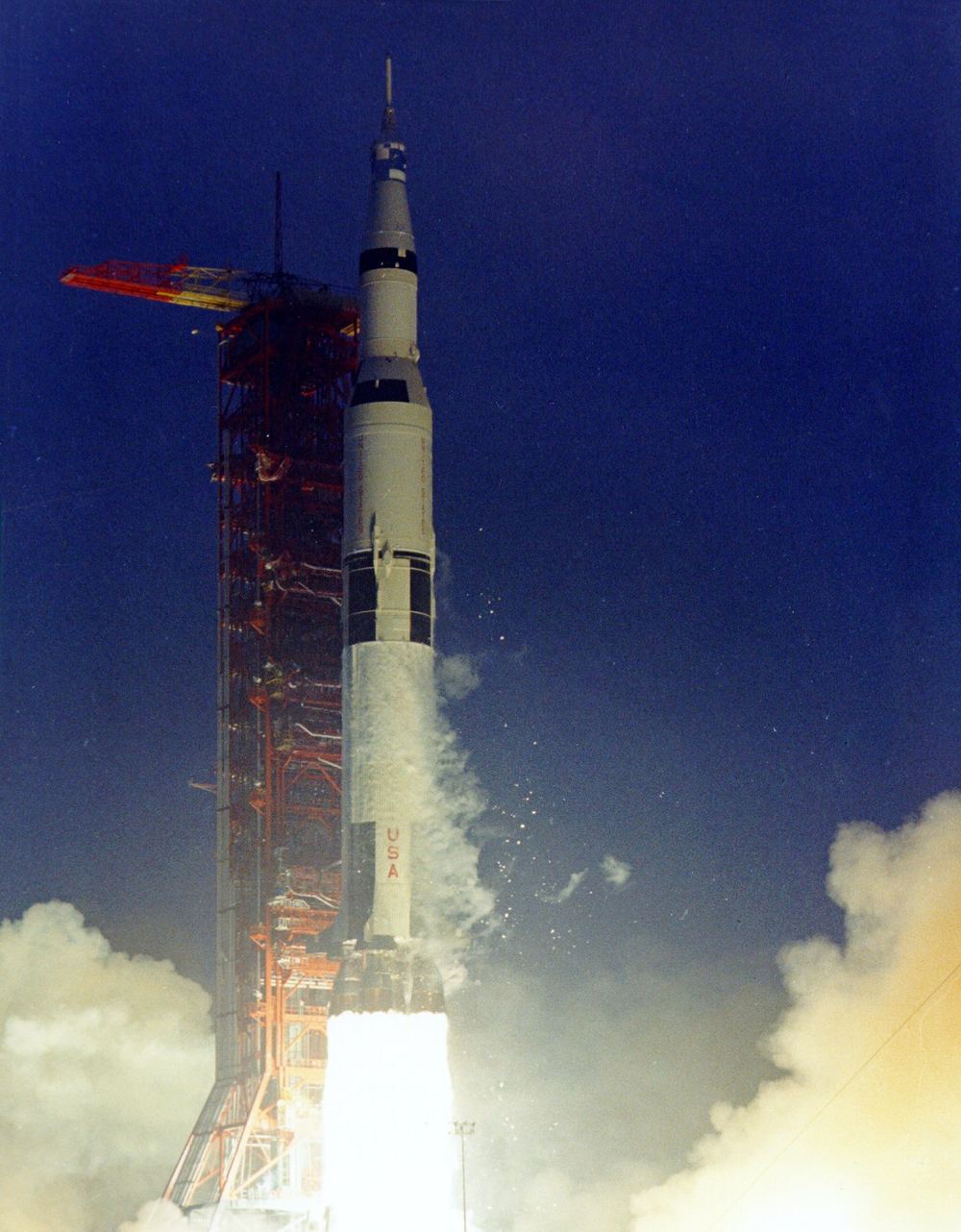
The launch had been delayed a couple of days for weather. When they finally launched this morning, November 14th, the sky was overcast and threatening — not ideal, but within limits. The Saturn V ignited at 11:22 AM Eastern. I watched on television. The rocket rose. Standard ascent. And then, thirty-six seconds into the flight, something happened that I didn’t immediately understand from watching the television coverage.
Lightning struck the Saturn V. Then lightning struck it again, twelve seconds later. Two separate lightning strikes on a spacecraft in flight carrying three men to the Moon.
The crew — Pete Conrad, Dick Gordon, and Alan Bean — suddenly had alarms everywhere. Their electrical system had gone haywire; the lightning triggered the fuel cells to disconnect from the main bus. Most of the spacecraft’s displays went dark or wrong. Conrad’s voice on the radio was controlled but quick: “Okay, we just lost the platform.” The inertial navigation system had lost alignment. They were thirty-six seconds off the ground and already in serious trouble.
Mission Control came very close to calling an abort. The Flight Director, Gerry Griffin, and the flight controllers were looking at a spacecraft whose telemetry data suddenly looked like nonsense.
Then one young flight controller named John Aaron — twenty-six years old, the EECOM (the electrical systems officer) — said something. He recognized the pattern from a test failure he’d seen a year earlier in a simulation. He knew what he was looking at. He called out: switch to “SCE to auxiliary.” A specific switch position that would restore power to the Signal Conditioning Equipment that sends data to the ground. Griffin said do it. CapCom Gerald Carr relayed it to the crew.
Alan Bean said “SCE to auxiliary?” He wasn’t sure where the switch was. He found it. He switched it. The telemetry data on the ground came back. The spacecraft, it turned out, was mostly fine — the lightning had caused electrical havoc but the navigation platform could be realigned using star trackers, and the guidance computer was working. They were going to be okay.
Conrad, Gordon, and Bean are on their way to the Moon.
I sat with this story for the rest of the day, reading everything that came over the radio and television. John Aaron. Twenty-six years old. Had seen a similar pattern in a simulation, memorized it, and in the moment that it mattered, he was right. They will call him “the steely-eyed missile man” in the future, I think. He earned it today.
Pete Conrad, for his part, seems unfazed. The mission transcript shows him conducting the malfunction procedures with what sounds like professional efficiency and maybe just a hint of “well, that was something.” He is exactly the kind of man you want in command of a spacecraft that just got hit by lightning.
Three men are on their way to the Moon. Again. For the second time. The second time! It’s extraordinary and I don’t want to take it for granted. But I also think about how close this came to ending very differently. Lightning. Twice. Thirty-six seconds in.
The space program is a series of near-catastrophes that were caught in time. That’s not entirely reassuring. But it’s also a tribute to the preparation — to the young engineers who stay late studying simulation data, who memorize obscure switch positions, who are ready when it matters. John Aaron was ready today. The mission continues because he was ready.