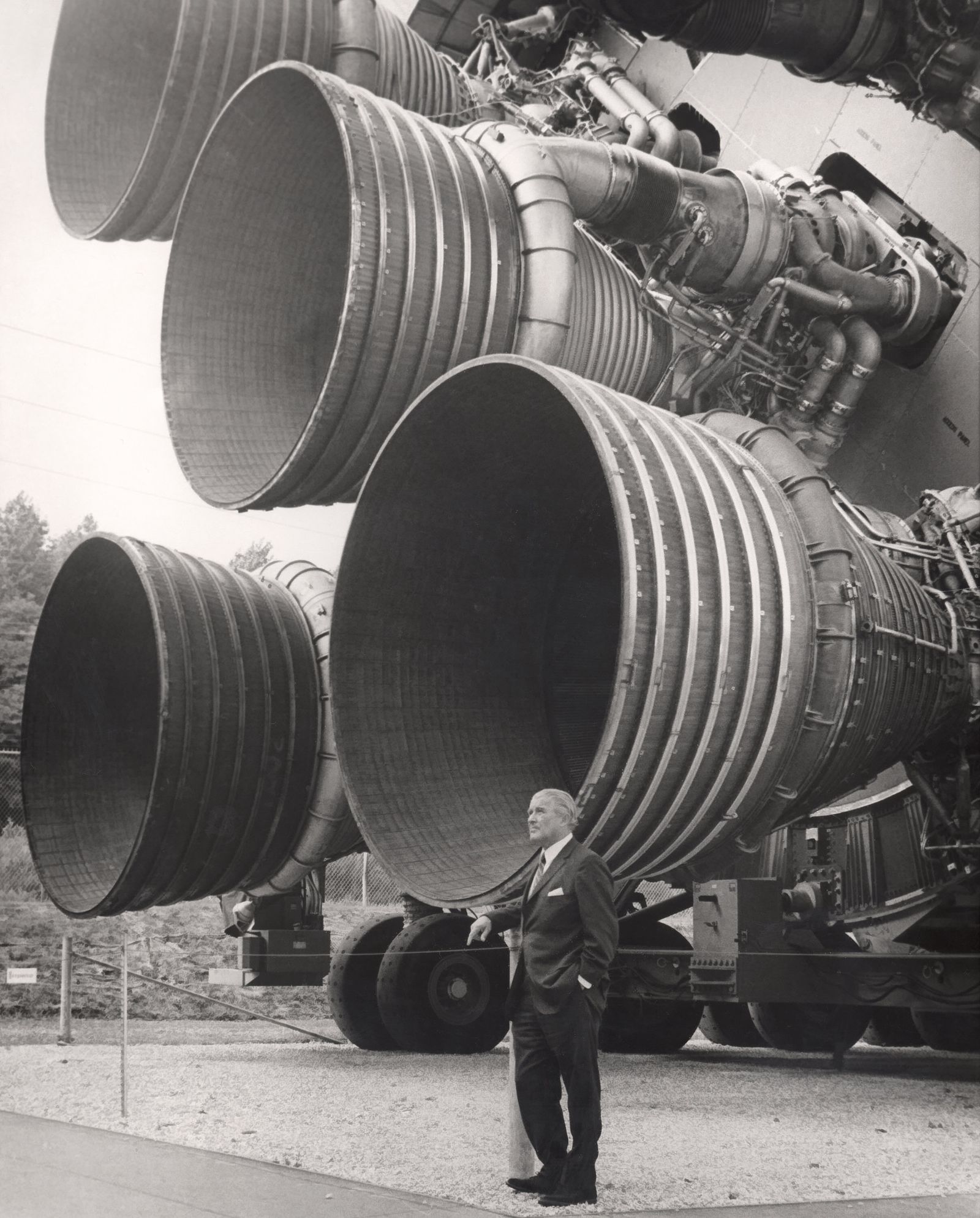
I’ve spent several weekends this fall reading about rocket propulsion because I wanted to understand why the Saturn V’s upper stages use liquid hydrogen and liquid oxygen instead of, say, kerosene and oxygen like the first stage.
The short answer: energy density. Liquid hydrogen, when burned with liquid oxygen, releases more energy per pound of propellant than any other chemical reaction we can practically use. That matters enormously when you’re trying to get somewhere with limited propellant.
The unit rocketry engineers use is “specific impulse” — essentially how many seconds of thrust you get per pound of propellant burned per second. Higher is better. The F-1 engine (kerosene/LOX) has a specific impulse of about 304 seconds. The J-2 engine (liquid hydrogen/LOX) has about 421 seconds. That 40% improvement is huge when you’re talking about the upper stages that have to push the crew to the Moon.
So why not use hydrogen everywhere? The problem is volume. Hydrogen has extraordinary energy per pound but terrible energy per gallon. Liquid hydrogen is so diffuse — it has to be stored at minus 423 degrees Fahrenheit, and even as a liquid it’s extremely light — that the tanks required to hold it for the first stage would be impossibly large. The first stage uses kerosene (RP-1) because the tanks stay manageable, and the raw brute-force thrust of the F-1 engines more than compensates for the lower efficiency.
The J-2 engines on the second and third stages of the Saturn V use hydrogen precisely because those stages are trying to extract maximum performance from the remaining propellant. They’re not fighting gravity off the launch pad; they’re in flight, optimizing efficiency.
There’s also a temperature problem that took years to solve. Liquid hydrogen is the coldest liquid that exists in practice — nearly absolute zero. When it flows through pipes into a combustion chamber burning at 5,000 degrees, every seal, every valve, every weld has to survive that thermal gradient. Metals become brittle at cryogenic temperatures. The engine starts cold and then the combustion chamber gets white-hot in milliseconds. Finding materials and designs that handle this consistently, for 500 seconds of burn time, required systematic testing that destroyed a lot of hardware.
Rocketdyne built the J-2 engine, the same company that built the F-1. They’re in Canoga Park, California. I’ve read about their test facility in the Santa Susana Mountains — they fire rocket engines on mountain test stands and the noise is apparently audible for miles. Neighbors have complained. Rocketdyne has, I’m told, explained that the noise is why we’re going to the Moon before the Soviets.
The chemistry of it, stripped down: hydrogen and oxygen combine to form water. That’s the exhaust. The Saturn V’s upper stages are, at the molecular level, burning hydrogen and making steam. Exhaust velocities around 14,000 feet per second. The chemistry is almost embarrassingly simple. The engineering to make that chemistry happen reliably, at scale, at extreme temperatures, repeatedly, without failure — that’s where all the complexity is.
I find that comforting somehow. The underlying physics is clean and tractable. The hard part is the engineering, and the engineering is something human beings figured out.