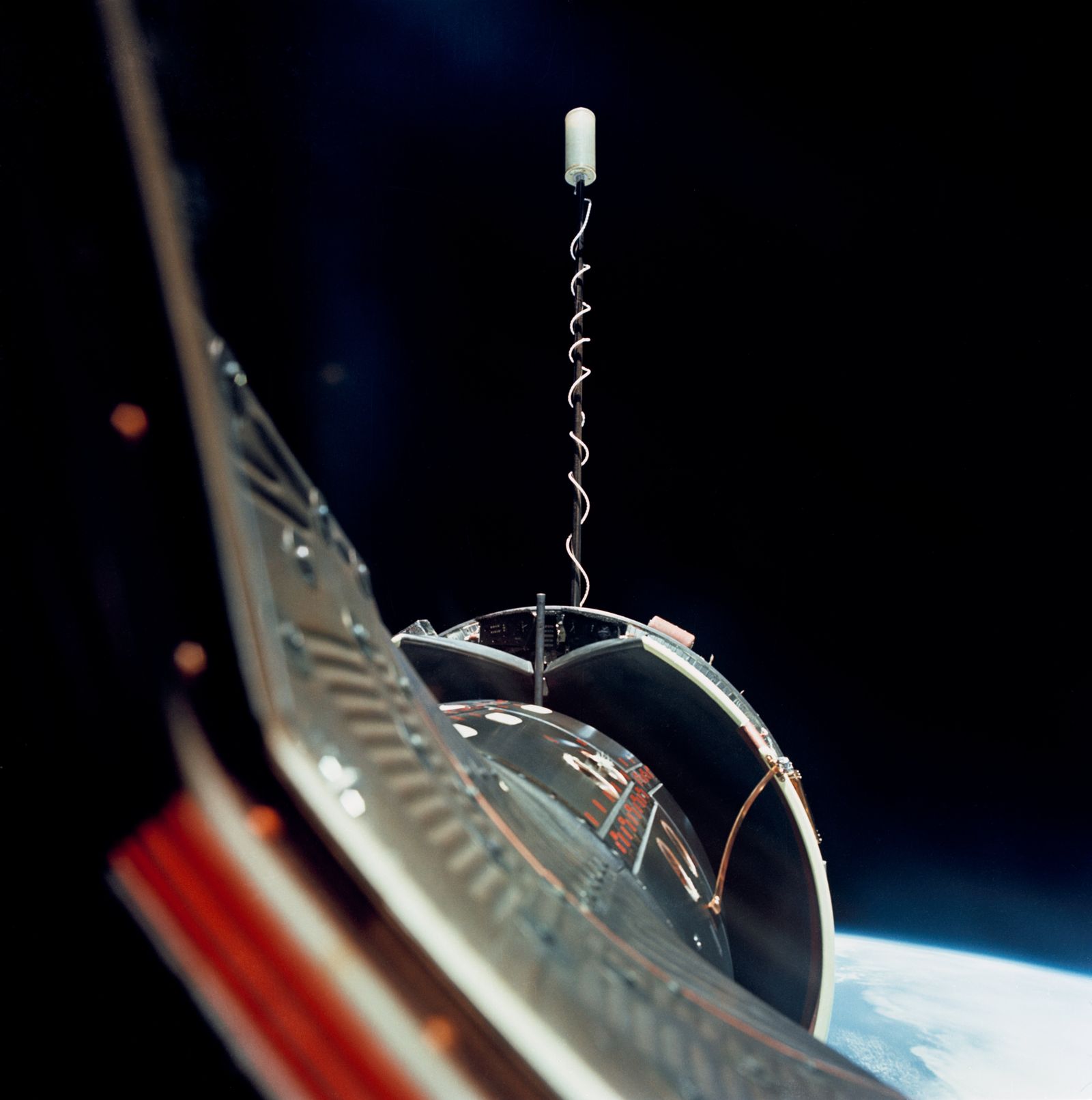
The Agena target vehicle has flown on more Gemini missions than I can easily keep track of, so let me explain what it is and why it keeps appearing.
The Agena-D is an upper-stage rocket that has been used by the Air Force for satellite launches for years. For the Gemini program, it was adapted as a target: launched on an Atlas rocket, it reaches a specific orbit, turns itself around to face the approaching Gemini capsule, and waits.
Why do you need a target? Gemini needs to practice rendezvous and docking — skills Apollo requires for the lunar mission. You need something to rendezvous with. The Agena is ideal: it has a standardized docking collar that matches the Gemini nose, it can fire its own engine (the astronauts can use this to change their combined orbit), and it’s well-understood hardware.
The complications: four of the Agenas launched for Gemini missions failed to reach orbit correctly, denying the crews their docking target. Gemini 6 lost its Agena and was repurposed into a rendezvous mission with Gemini 7 instead (a creative fix). Gemini 9’s Agena was replaced with the Augmented Target Docking Adapter, which then failed to jettison its shroud. Gemini 10 docked with both its Agena and the dead Gemini 8 Agena that was still in orbit. Gemini 11 used its Agena to boost to 853 miles. Gemini 12 docked cleanly and completed the EVA work that earlier missions had struggled with.
Six Agenas across six missions, each one adding to the collective understanding of what rendezvous and docking actually requires. The Apollo docking with the lunar module is the application of everything learned from these Agena flights.
The Agena itself is expendable — it stays in orbit after the Gemini mission ends, and its orbit decays over months or years, ending in atmospheric re-entry. Somewhere in the Pacific, probably, there are Agena components on the ocean floor that once helped train astronauts for the Moon.