Here is something that has never happened before in the history of the human race: two spacecraft piloted by human beings have met in orbit. Not docked — that comes later. But met. Frank Borman and Jim Lovell in Gemini 7, which had been in space since December 4th; and Wally Schirra and Tom Stafford in Gemini 6A, which launched yesterday. They flew within a foot of each other, roughly 185 miles above Earth.
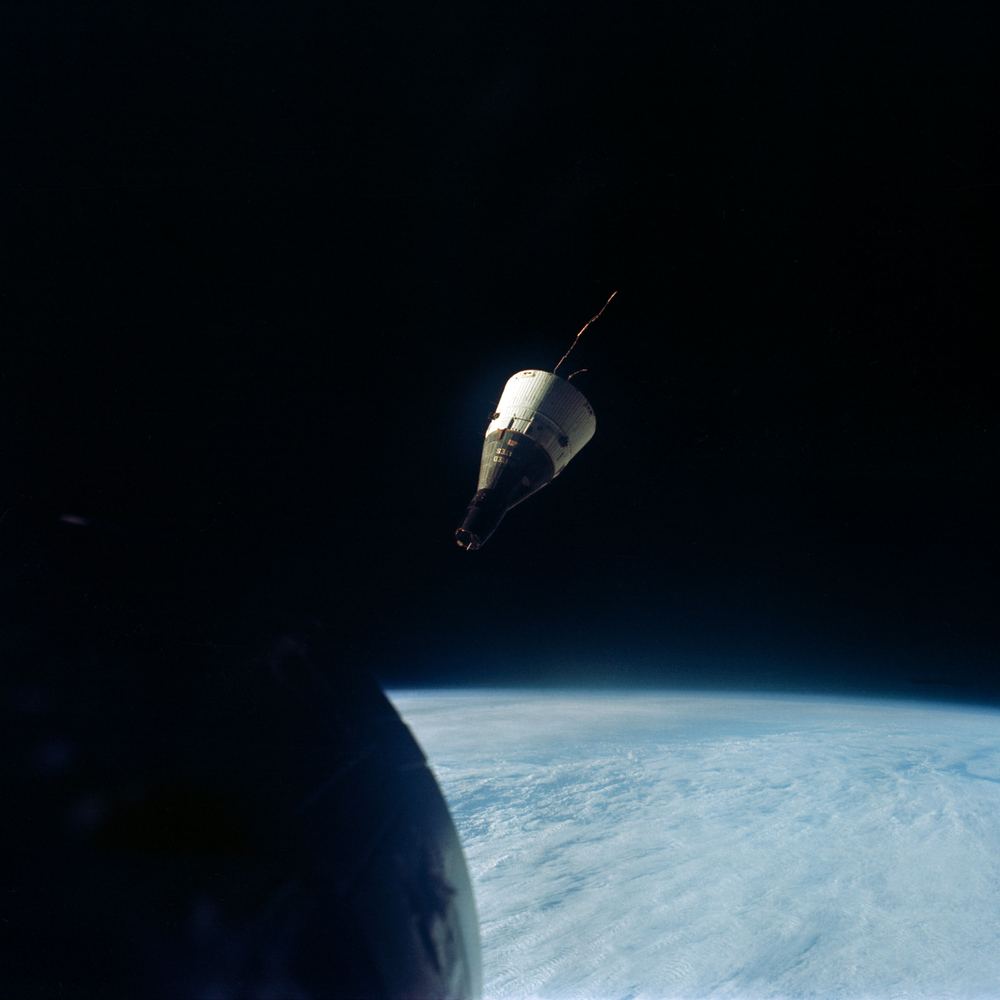
A foot. That’s twelve inches. At 17,500 miles per hour.
The orbital mechanics required for this boggle my mind, and I’ve been trying to understand them since I read the first articles. You would think that if you want to catch up to a spacecraft ahead of you, you would fire your engine and speed up. But that’s not how it works in orbit. If you speed up, you go to a higher orbit, and a higher orbit takes longer to complete — so you actually fall behind. To catch up, you have to slow down first, drop to a lower orbit, go faster in that lower orbit, and time the whole thing so you arrive at the right place at the right moment.
I explained this to Betty and she looked at me the way she sometimes does — patient, kind, faintly skeptical — and said, “So they caught up to the other one?” Yes, I said. They caught up. The crews waved at each other through their windows. Lovell held up a sign that said “BEAT ARMY” — he’s a Naval Academy man and Stafford went to Air Force. Even in orbit, the old rivalries persist.
Borman and Lovell have been in space for eleven days now, which is a record. They’re going for two weeks — the length of a Moon voyage and return. Their job is endurance. Can the human body tolerate two weeks in space? It’s deeply uncomfortable, apparently — the Gemini capsule is about the size of the front seat of a small car, and two men have been in there for nearly two weeks, barely able to move. But their bodies seem to be holding up.
Schirra and Stafford were there for the rendezvous and then backed away. They’ll come home in a day or two. Borman and Lovell will stick it out to the full two weeks.
But the rendezvous is the milestone. Because here’s why this matters, and Betty was right to point it out: the plan to go to the Moon requires a spacecraft to leave Earth, travel to the Moon, separate into two pieces, have one piece land and one piece stay in orbit, and then have the two pieces FIND EACH OTHER and dock again in lunar orbit before coming home.
If we can’t rendezvous — if we can’t find one spacecraft with another in the emptiness of space — we can’t get the crew home from the Moon. They’ll be stranded in lunar orbit or lost on the surface forever. The rendezvous isn’t a technical footnote. It’s a survival requirement.
Yesterday, two American spacecraft flew within a foot of each other in orbit. The technique works. The navigation works. The crew training works. The mission planning works.
We can find things in space. We can meet up. We can come within a foot of each other at 17,500 miles per hour and stay there and wave through the window.
I think we’re going to the Moon.
Not this year, and probably not next year. The Gemini program still has several missions to go. The Apollo spacecraft is still being built and tested. There are a thousand things that could go wrong. But I think, watching this unfold, that Kennedy’s promise is not impossible. It’s actually happening. Mission by mission, skill by skill, problem by problem, we’re building the capability to do the impossible thing.
I called my parents tonight and told my father about the rendezvous. He’s seventy-one and served in the First World War. He said, “Two spacecraft in orbit at the same time?” I said yes. He was quiet for a moment and then he said, “Well. I’ve lived to see everything.”
I think that might be exactly right.