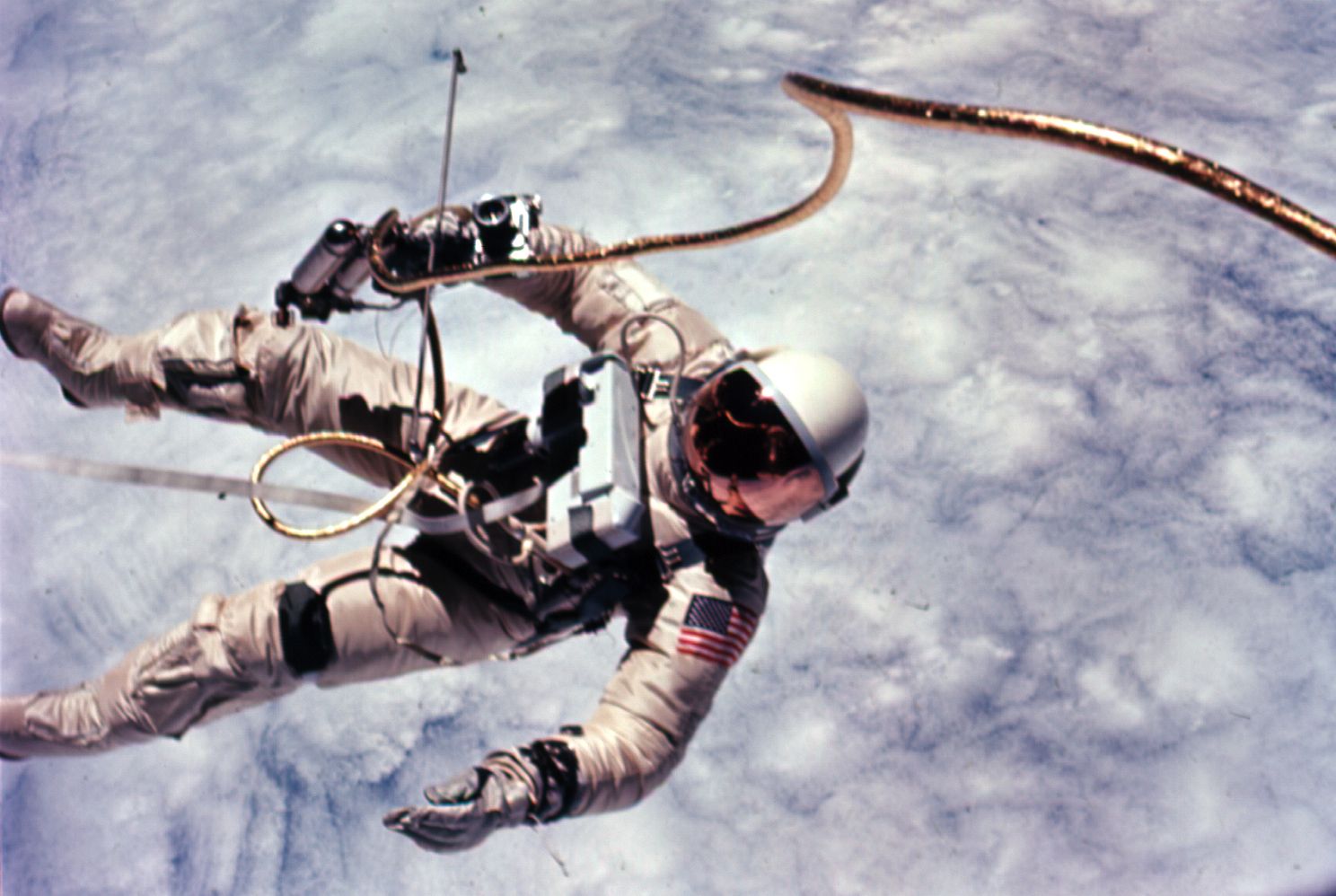
My kids gathered around the television this afternoon and we watched a man float outside his spacecraft over the Earth.
Edward H. White II — Ed White — opened the hatch of Gemini 4 this morning while the spacecraft was somewhere over Hawaii, at an altitude of around 120 miles, going approximately 17,500 miles per hour. He pushed himself out of the capsule and floated. He was wearing a spacesuit and had a tether connecting him to the spacecraft and a small handheld maneuvering gun that let him propel himself around.
He was outside for twenty-three minutes.
Twenty-three minutes outside the spacecraft, above the Earth, in space. He could see the continent of the United States below him. He said he could see individual cities. He floated over the Gulf of Mexico and the Atlantic. He tumbled and laughed. He’s an Air Force pilot, a graduate of West Point and the University of Michigan — exactly the kind of man you’d expect to be calm about something like this. But you can hear in the audio recordings — they played portions of them on television — that he is delighted. Not just calm. Delighted. This man is having the time of his life.
At the end of the twenty-three minutes, the mission commander James McDivitt told him he had to come back in. White replied, “I’m coming back in, and it’s the saddest moment of my life.”
I replayed that in my head for the rest of the afternoon.
The saddest moment of my life. To be outside the spacecraft, floating above the Earth, in the silence of space — and then to have to go back inside the capsule because the mission plan says so. I understand why McDivitt called him in; they were burning through time and resources, and White still had to get back inside and seal the hatch before reentry. Mission rules are mission rules. But I understand White too. Who would want to come back?
There was a Soviet spacewalk earlier this year — Alexei Leonov in March, outside the Voskhod 2 capsule. He went out for twelve minutes. What the Soviet news didn’t mention, at least not immediately, was that Leonov nearly didn’t make it back in — his suit had inflated in the vacuum of space and he couldn’t fit through the hatch. He had to bleed air out of the suit, risking decompression sickness, to get back inside. He made it. But it was considerably closer than the official reports suggested.
White’s EVA went smoothly. His suit worked. His maneuvering gun worked. The tether worked. He came back in when told, even if reluctantly. America’s first spacewalk was a success.
My daughter asked me tonight what it must feel like — to be outside the spacecraft. To be floating in nothing, with nothing between you and the stars except a spacesuit. I said I thought it must feel terrifying and magnificent in equal measure. She said she would want to do it. She’s twelve years old and she wants to go to space. I did not think this was a realistic aspiration when she was nine, when she first said it. I’m less certain now.
The Gemini program is doing exactly what it’s supposed to do: learning how to work in space. Spacewalks, rendezvous, long-duration flights — all the skills needed to go to the Moon. Each mission teaches something. This one taught us that a man can work outside a spacecraft, can maneuver, can perform tasks in the vacuum of space. That’s not a small thing.
The Moon is getting closer. Not literally — it’s still 240,000 miles away. But the distance between what we know how to do and what we need to know how to do is shrinking mission by mission.
I hope White gets another flight. I hope they send him to the Moon someday. He seems like exactly the kind of man who should see it.