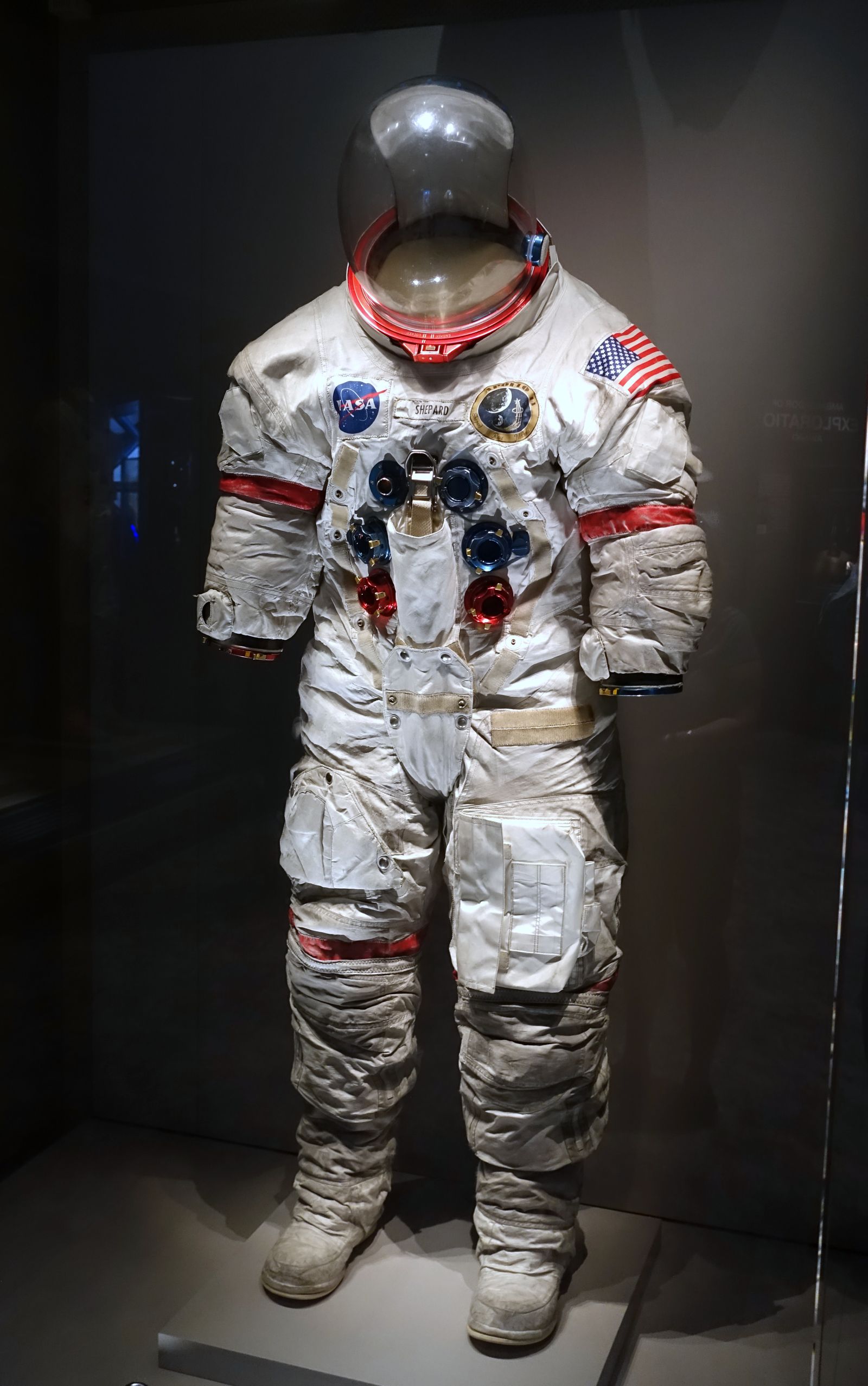
People don’t think about spacesuits much when they think about going to the Moon. They should.
A spacesuit is a personal spacecraft. Everything the larger vehicle does — maintain pressure, regulate temperature, filter air, protect from radiation and micrometeorites — the suit has to do too, in a package you can wear and move in. And it has to do it for hours at a time, on the surface of the Moon, in vacuum, with temperature swings from 250 degrees Fahrenheit in direct sunlight to minus 250 degrees in shadow.
I’ve been reading about the development problems. The early Mercury suits were modified high-altitude pressure suits from the military, designed to maintain pressure if the capsule lost pressure. They weren’t designed for EVA — for actually going outside and working. The Gemini suits improved on this, but the Gemini EVA difficulties I’ve written about (astronauts exhausting themselves, unable to complete tasks) revealed serious problems. If a suit makes it impossible to work, it’s not doing its job.
Hamilton Standard is the main contractor for the Apollo suits. ILC Industries is doing the actual suit fabrication. The suit has 21 layers: an inner pressure bladder, a restraint layer to keep the bladder from ballooning when pressurized, thermal insulation layers, and an outer layer of Teflon-coated fabric that resists abrasion and fire. The boots have layers of aluminum for thermal protection.
The gloves are the most critical and most difficult piece. An astronaut on the Moon has to pick up rock samples, operate cameras, plant flags, drive equipment. The glove has to be flexible enough to do all of this while pressurized — and pressurized gloves resist bending because air pressure wants to push the fingers straight. The solution involves putting extra fabric pleats at each knuckle, so the finger joints have slack to bend into.
I tested this concept on my own hand by rolling up a rubber glove cuff with air in it and trying to flex my fingers. It’s harder than you think. And that’s at Earth atmospheric pressure; the suit operates at a lower pressure specifically to make this easier, but lower pressure means the astronaut has to pre-breathe pure oxygen before EVA to purge nitrogen from the blood (otherwise reduced pressure can cause the bends, same as a diver surfacing too fast).
The helmet has a gold-coated visor that reflects infrared radiation — that’s why lunar surface photographs show astronauts in reflective golden visors. The visor is the astronaut’s primary protection against solar radiation, which on the Moon is unfiltered by any atmosphere.
The whole system — suit, backpack (portable life support system), gloves, helmet, boots — weighs about 200 pounds on Earth. On the Moon, with one-sixth gravity, it weighs about 33 pounds. But it’s still 200 pounds of mass to carry around, and the bulk of it affects how you move.
I keep a mental list of things the Moon program requires that weren’t on anyone’s engineering agenda twenty years ago: guidance computers small enough to fly on a spacecraft, rocket engines with unprecedented reliability, life support systems for two weeks in space, suits that let you work on a planetary surface.
The suit people have one of the hardest jobs and get among the least credit. Without the suits, no one walks on the Moon. I hope they know how important they are.