I took a half-day from work. The boss looked at me over his glasses and said, “Glenn flight?” and I said yes, and he waved me out without another word. I think he went home early himself.
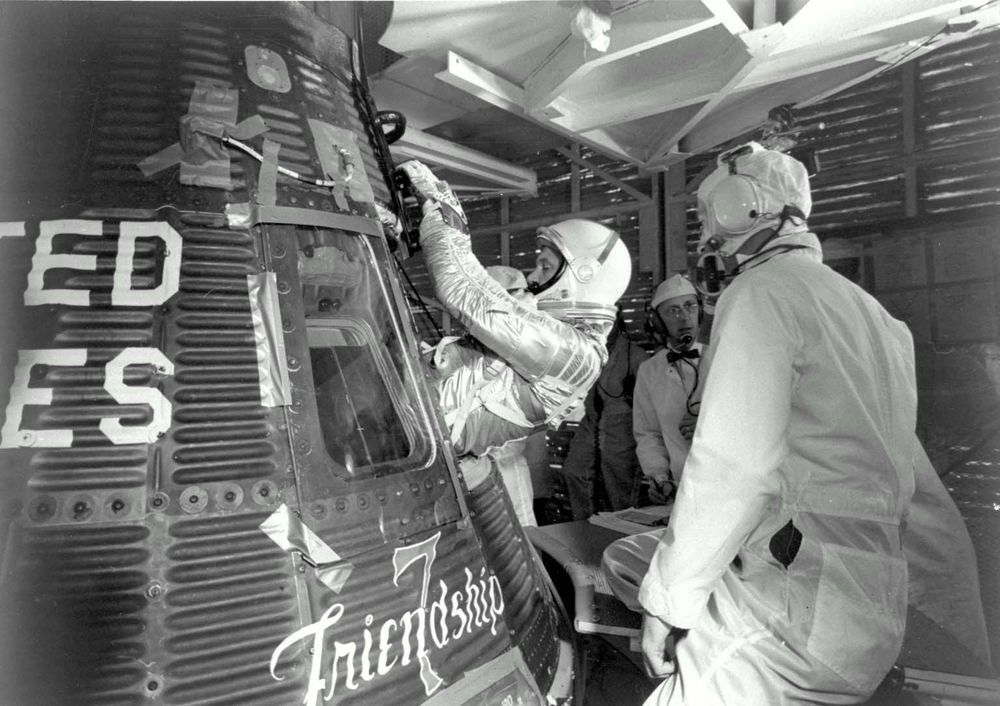
Betty was already at the television when I got there. She’d made sandwiches. The kids were in school — I thought about calling them home but decided against it; it would be chaos and they could watch the news tonight. So it was just Betty and me, sitting close together on the couch, watching the launch coverage from Cape Canaveral.
The launch had been delayed. Again. I’ve lost count of how many times the Glenn launch has been postponed — weather, technical problems, one thing and another. It’s been weeks of waiting. But today, February 20th, 1962, the launch went forward. The Atlas rocket — a different vehicle than Shepard’s Redstone, much more powerful — ignited at 9:47 in the morning.
I watched John Glenn go to orbit.
He went around the Earth three times. Three complete circles of our entire planet, going roughly five miles per second, taking about 88 minutes per orbit. When they showed the ground track on a map — a line wiggling across the continents and oceans — I tried to follow it with my finger and couldn’t quite keep up. He was over Australia. He was over the Indian Ocean. He was over California. He was coming up on Florida. Each lap took less than an hour and a half.
There was a scare that I only found out about afterwards, in the news. During the second orbit, a sensor indicated that the heat shield — the thing that protects the capsule during reentry, the thing that keeps the astronaut from burning up — might be loose. Mission Control made the decision not to tell Glenn (at least not everything) but to have him keep the retrorocket package attached during reentry, in case it could hold the heat shield in place. This meant a more uncomfortable reentry — the retropackage burns and breaks apart against the heat — but it was their backup plan.
The heat shield was fine. The sensor was faulty. Glenn came through reentry without incident.
But here’s the thing: for those final minutes of reentry, when Glenn was going through radio blackout — when the ionized plasma around the capsule cuts off all communication — nobody knew for certain whether he was okay. The announcer on television filled the silence with careful words. Betty’s hand found mine on the couch.
Then Glenn’s voice came through. Clear. Calm. “That’s a real fireball outside.” He was describing the reentry from inside the capsule, watching the flames. He was alive. He was fine. The capsule came down on its parachutes into the Atlantic Ocean and the recovery ship was there waiting.
I let out a breath I had apparently been holding for quite a while.
John Glenn is forty years old. He was a Marine pilot in both World War II and Korea. He set a transcontinental speed record in 1957. He’s one of the original seven Mercury astronauts and he has been waiting for this flight for years while Shepard and Grissom went first on the shorter suborbital missions. He waited with enormous grace and patience, from everything I’ve read. He got his orbit.
The ticker-tape parade in New York is being planned for next week. I’m sure it will be magnificent — I saw footage of Shepard’s parade and it was enormous, but this feels like something different. Shepard went to the edge of space and came back. Glenn circled the world. Three times. He saw the Earth the way no American had ever seen it before, from orbit, and he came home, and something about that feels like a turning point.
I walked outside after dinner and looked up. There were clouds, so I couldn’t see much. But I stood there anyway for a few minutes, thinking about the fact that somewhere up above those clouds — not very far up, really, in the cosmic scheme of things — John Glenn had been this morning. One of us. Going around and around and around our spinning planet, at five miles per second, watching sunrises and sunsets tick past every forty-five minutes.
I think we might actually do this.