Skylab launched on May 14 and immediately began falling apart.
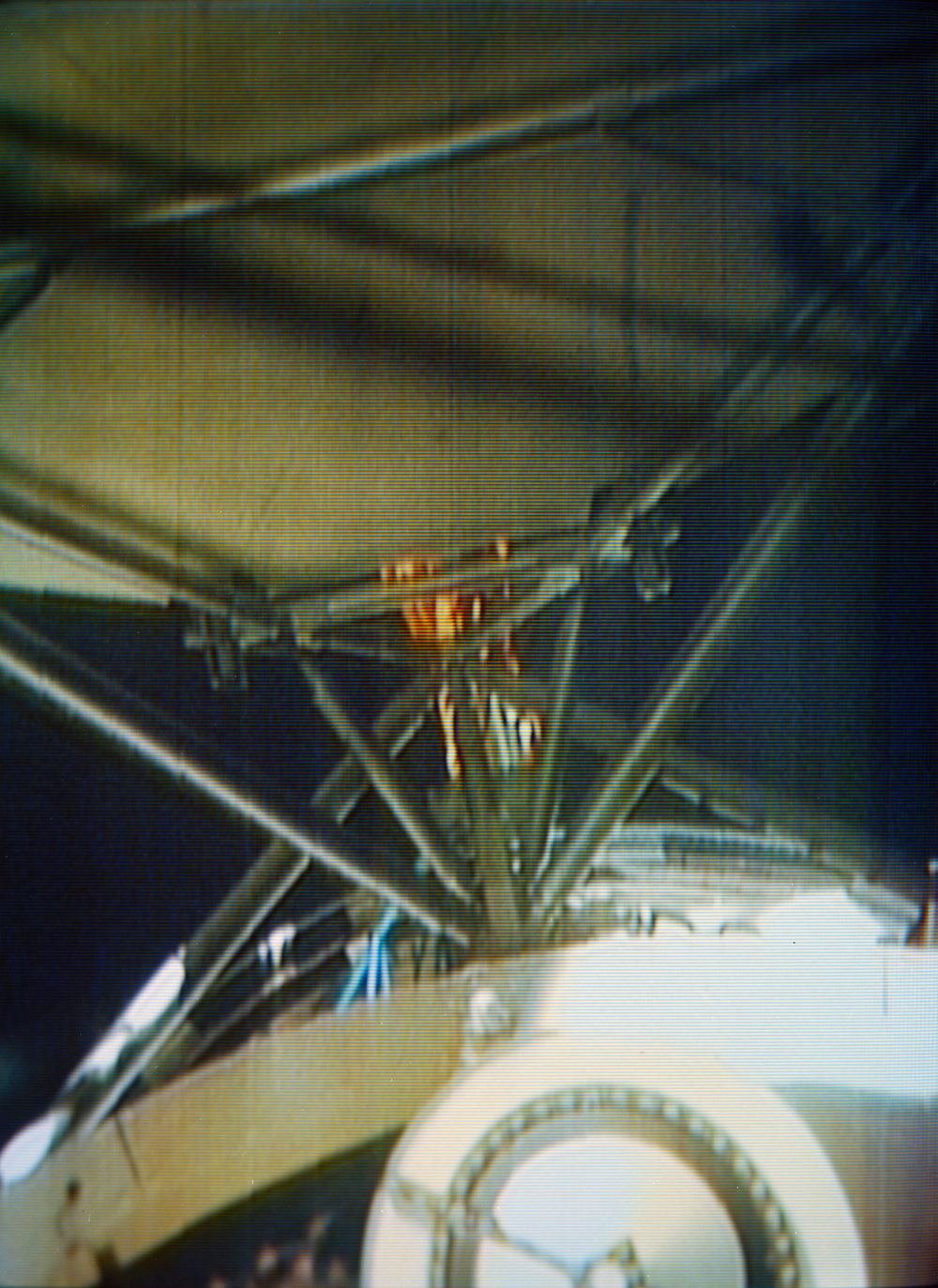
The meteoroid shield — a thermal protection and micrometeorite deflector that wrapped around the outside of the workshop — tore off during launch. The debris took one of the two solar panel wings with it. The remaining solar panel was also jammed partially deployed.
Without the thermal shield, internal temperatures in the workshop climbed past 125°F. Without both solar panels, the power budget was catastrophically reduced. The first crew — Pete Conrad, Joe Kerwin, Paul Weitz — had their launch delayed for 10 days while engineers on the ground designed emergency repairs.
Two repairs were needed: a thermal shield to cool the interior, and releasing the jammed solar panel.
The thermal shield was improvised from materials on hand. Engineers designed a “parasol” — a multi-layer deployable shade made from nylon, mylar, and aluminized mylar — that could be pushed through a scientific airlock and deployed over the exterior of the workshop. They had ten days to design, build, and test it, and train the crew on deployment. They did it.
The solar panel fix required a spacewalk: Conrad and Kerwin cut a jammed strap with bolt cutters on the end of an EVA pole, and the wing deployed.
The crew moved into the repaired station in a habitat that was still warm but livable. They stayed 28 days, conducted all their planned scientific observations, and came home.
I keep noting these stories because they keep being the same story: things go wrong, human intelligence improvises, mission continues. This is the redundancy I’ve been writing about for sixteen years. Not just the physical redundancy of backup systems, but the human redundancy of problem-solving capability — the ability to respond to the unanticipated.
The parasol people never planned for a parasol. They built it in ten days with the right materials because they understood the problem clearly enough to find a solution that didn’t exist yet.
That’s engineering. That’s the whole program, in miniature.