Apollo 12 proved something beyond the fact that we can go to the Moon: we can aim.
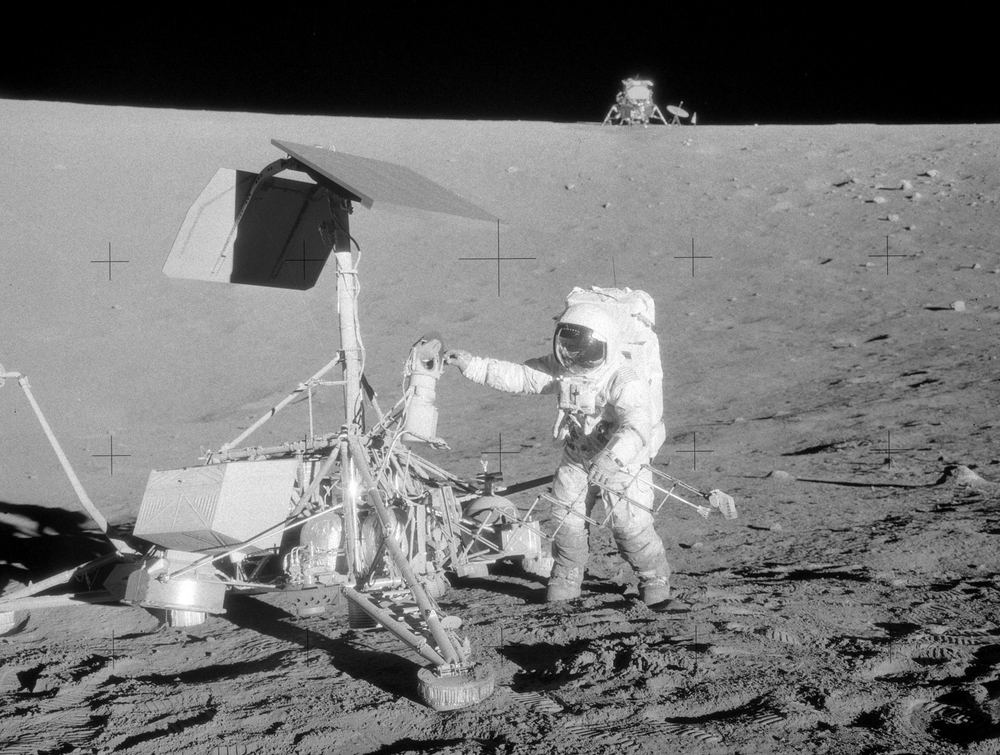
Pete Conrad landed the Intrepid within 600 feet of Surveyor 3. 600 feet. They targeted a specific spacecraft on the lunar surface from Earth, flew a rocket to the Moon, descended through twelve minutes of powered flight, and set down close enough to walk to their target.
Conrad and Bean walked to Surveyor 3, examined it, cut off pieces including the television camera, which was returned to Earth for analysis. (The scientists want to know how lunar surface conditions affected the hardware over two and a half years.) The spacecraft had a thin coating of lunar dust and appeared structurally intact, though the white paint had darkened to brown — possibly from solar UV exposure.
The precision landing changes what’s possible. The first landing (Apollo 11) had to be general-area targeting. Armstrong manually flew the last hundred feet to avoid a boulder field, which is exactly what manual override is for, but which moved them from the planned spot. Apollo 12’s landing showed that when the terrain cooperates, you can hit your target.
Future missions will be able to land in the Highland terrain, which is scientifically more interesting but more challenging — older rocks, rougher surface. The navigation and landing systems we’ve been developing can handle it.
Conrad and Bean also spent 7.5 hours on the surface across two EVAs — the longest surface stay so far — and brought back 75 pounds of samples. The samples include basalt that’s older than the Tranquility samples, from deeper lava flows. The geology picture is getting richer.
I keep thinking about the piece of Surveyor 3’s camera that’s now in a laboratory at JPL. A camera that we sent to the Moon in 1967, that we checked up on in 1969, that we brought a piece of back. The Moon is no longer a destination. It’s a place we visit.
For now. I hope.