I’ve been thinking about the camera. The one that showed us Armstrong’s first step. How did they get a picture from the Moon?
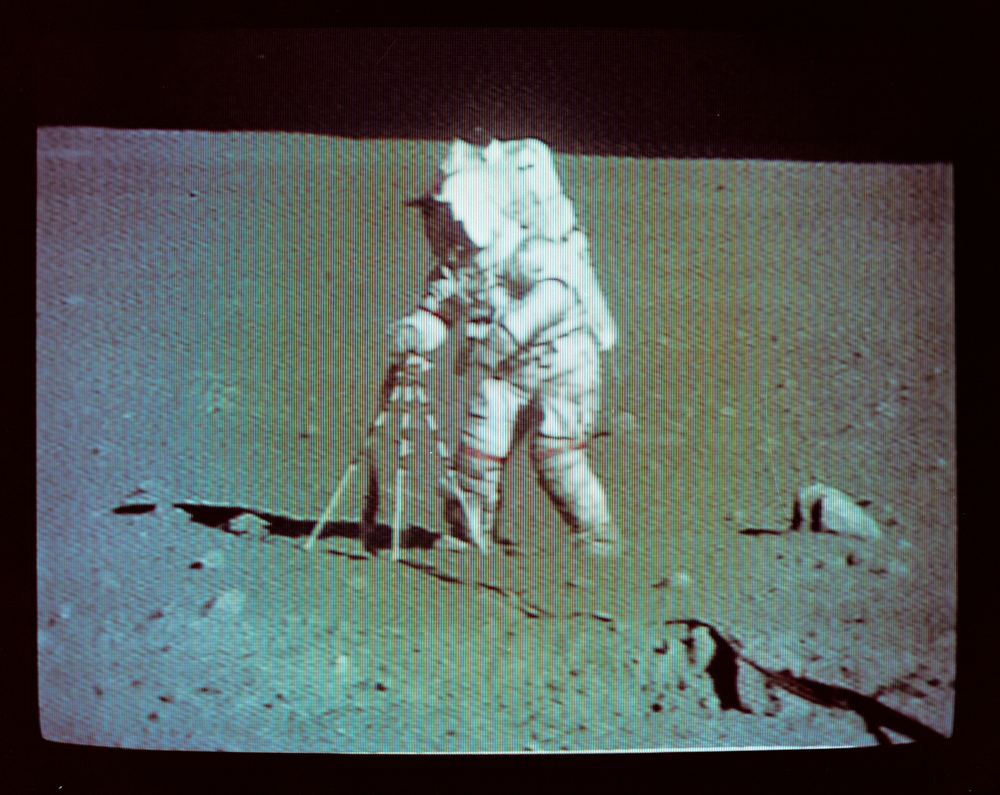
The Westinghouse slow-scan television camera was attached to the descent stage of the Eagle lunar module, pointed at the ladder. When Armstrong opened the hatch and prepared to descend, Mission Control activated the camera. The signal traveled 240,000 miles to the 85-foot dish antennas at three receiving stations: Goldstone in California, Honeysuckle Creek in Australia, and Parkes Observatory also in Australia.
Parkes wasn’t the primary station for the EVA; Honeysuckle Creek was. But early in the EVA, the Parkes signal was stronger and the video clearer, so the signal was switched to Parkes. The famous ghostly images of Armstrong coming down the ladder were received primarily at Parkes.
The camera operated at 10 frames per second rather than the American television standard of 30. This was necessary to fit the video signal within the available radio bandwidth from the Moon — you can’t transmit 30-frame video over a long-range radio link without enormous bandwidth. The 10-frame signal was then processed and upconverted to 30 frames for broadcast.
The result was the grainy, slightly jerky, high-contrast images that went out on every television in the world. The technical limitations of the system are actually part of the memory — the otherworldly appearance of the footage, the ghostly white figure descending a ladder in a black sky, is partly the artifact of slow-scan television and long-range radio transmission.
There are people who point to the poor image quality as evidence that the whole thing was faked. I don’t have patience for this argument except to note that the image quality is exactly what the engineering of the transmission system would predict, and is consistent with the reception challenges.
At Parkes, the operators had to handle a local crisis during the EVA: winds reached 100 kilometers per hour, which was beyond the antenna’s rated limit, and the dish was at risk of being damaged. They kept it running anyway, accepting the risk. The images stayed on.
Nobody got credit for that decision. The Parkes operators kept the dish aimed at the Moon in unsafe wind conditions because they knew what was riding on it. 600 million people saw Armstrong step onto the Moon because some engineers in Australia decided to accept a risk.
There are hundreds of stories like that from the whole program. People who held things together in the moments when they needed to be held.