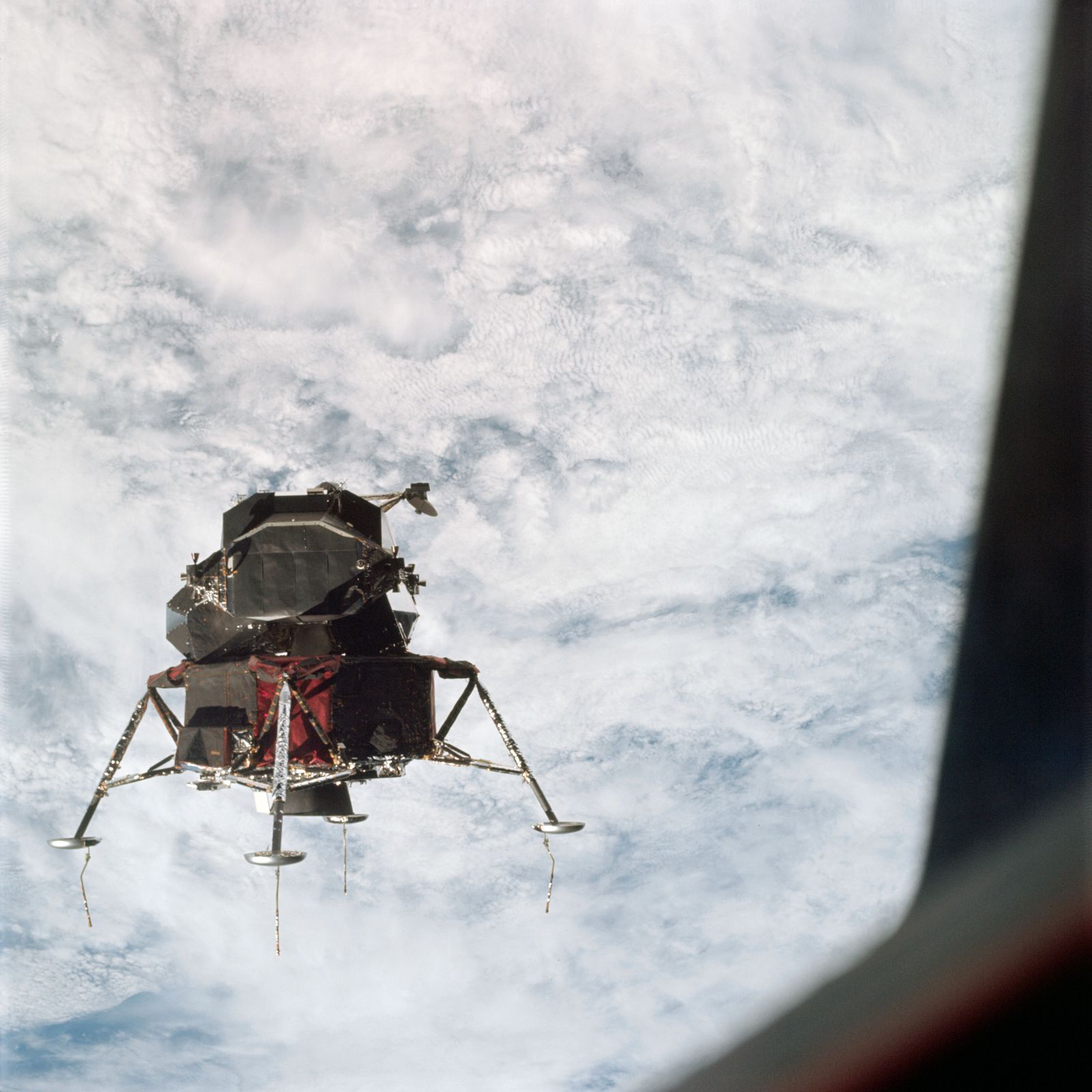
The lunar module flew for the first time with humans aboard today.
Apollo 9 has been in Earth orbit for five days now, and today Jim McDivitt and Rusty Schweickart took the lunar module — call sign “Spider,” because the crew thought it looked like a spider, which it does — on a solo flight. They undocked from the command module (call sign “Gumdrop”), flew Spider 100 miles away, fired the descent engine, fired the ascent engine, and rendezvoused and docked again with Dave Scott in Gumdrop.
The mission I’ve been writing about for two years — the one that requires undocking the lander, descending, and returning — its fundamental architecture was validated today in Earth orbit.
The lunar module is a genuinely strange spacecraft. It was designed purely for space — it will never operate in an atmosphere, so it has no aerodynamic considerations. It has two engines (descent and ascent), legs for landing, two hatches, two windows, and enough life support for two people for 50 hours. It looks, as the crew noted, like a giant spider or a crumpled tin can. It is not beautiful. It is functional.
Schweickart also did a spacewalk — emerging from the lunar module’s front hatch to stand on the porch, testing the suit and systems needed for lunar surface operations. He was supposed to transfer across the outside of the docked spacecraft to the command module, but he had some nausea and the EVA was shortened. The suit and systems worked; the transfer procedure can be refined.
The critical test passed: Spider flies. Two men can take the lander away from the command module, maneuver it, fire both its engines, and return to dock. Dave Scott was alone in Gumdrop during the period when Spider was undocked — exactly the situation that will occur when two astronauts land on the Moon and the third orbits waiting for their return.
This is the dress rehearsal for the dress rehearsal. The landing is two missions away.
Apollo 10 will take the lunar module to lunar orbit and descend to within 50,000 feet of the surface without actually landing. Then Apollo 11 will be the real thing — if everything keeps working.
Two missions. This summer.