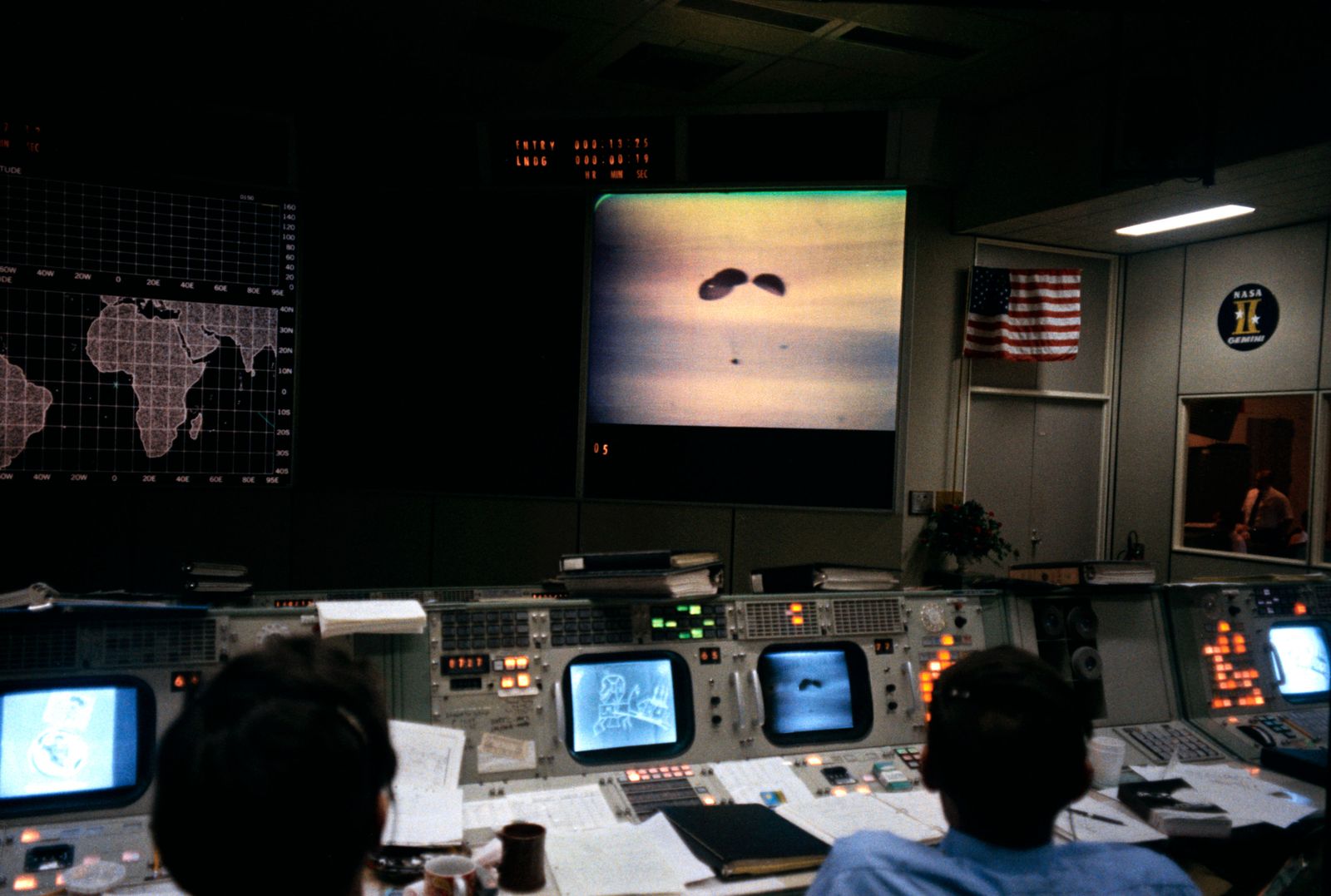
I’ve been thinking about the people in Houston I never see in the photographs.
The astronauts get all the press. Their names are in the headlines and their faces are on magazine covers. But Mission Control is the other half of every spaceflight, and I’ve been reading enough now to understand what they actually do.
Flight Director is the most important title in Mission Control. The Flight Director has ultimate authority over the mission — more authority, in some respects, than anyone on the ground, including the NASA administrator. The flight director’s word is final. If something goes wrong and a decision has to be made in seconds, the flight director decides. Failure is on them. Success is theirs too.
Gene Kranz is becoming the most prominent of them. He’s a former Air Force pilot, 32 years old, speaks in clipped precise sentences, and apparently wears white vests to every mission as his personal statement of professionalism. His team is known internally as “the White Team.” He goes into every mission with what he calls the “tough and competent” mantra — his whole management philosophy in three words. He was flight director for Gemini 8, the one where Neil Armstrong’s capsule started spinning. The mission was cut short, but both astronauts came home. Kranz and his team made the right calls in real time.
Below the flight director is a room full of flight controllers, each responsible for one system: propulsion, power, guidance, life support, trajectory, communications. They’re mostly young — late 20s, early 30s. The engineers and scientists who build spacecraft in the previous decade are now in their 40s and 50s; the people running the consoles are a new generation trained specifically for this. Many of them came out of universities in the mid-1950s, motivated by Sputnik to go into aerospace engineering. They’ve spent their careers building toward this moment.
The communications discipline is partly what makes Mission Control work. Every controller has a specific responsibility. They don’t speak up about things outside their lane. They stay in their seats until the flight director releases them. They know their systems at a level that allows them to diagnose problems from telemetry data in real time, often faster than the crew can describe what’s happening.
Flight controllers aren’t on the news. You don’t see them in the ticker-tape parades. But when John Glenn’s heat shield sensor indicated a loose heat shield, it was a flight controller who had to evaluate the data, determine whether it was likely a false alarm, and recommend a procedure that might keep Glenn alive if it wasn’t. That calculation — done in minutes, under pressure, without knowing the answer — is what a flight controller does for a living.
There are also the FIDO (flight dynamics officer), who computes trajectories; the GUIDO (guidance officer), who monitors the onboard computer; and the SURGEON, who monitors the crew’s medical telemetry. There’s a surgeon sitting in Mission Control for every manned mission, watching heart rate and respiration and blood pressure through sensors in the suits, ready to advise.
I think about that sometimes. Somewhere in Houston, there is a doctor watching an astronaut’s heart rate on a screen, three hundred miles away from the astronaut. If the astronaut’s heart rate changes, the doctor will know before the astronaut does.
We take a lot of this infrastructure for granted. The cameras go to the launch pad, to the capsule interior, to the recovery ship. Very rarely to the room full of young engineers in ties and short sleeves who are watching every sensor on every system and building the scaffolding that keeps the astronauts alive.
I want to remember them too.